
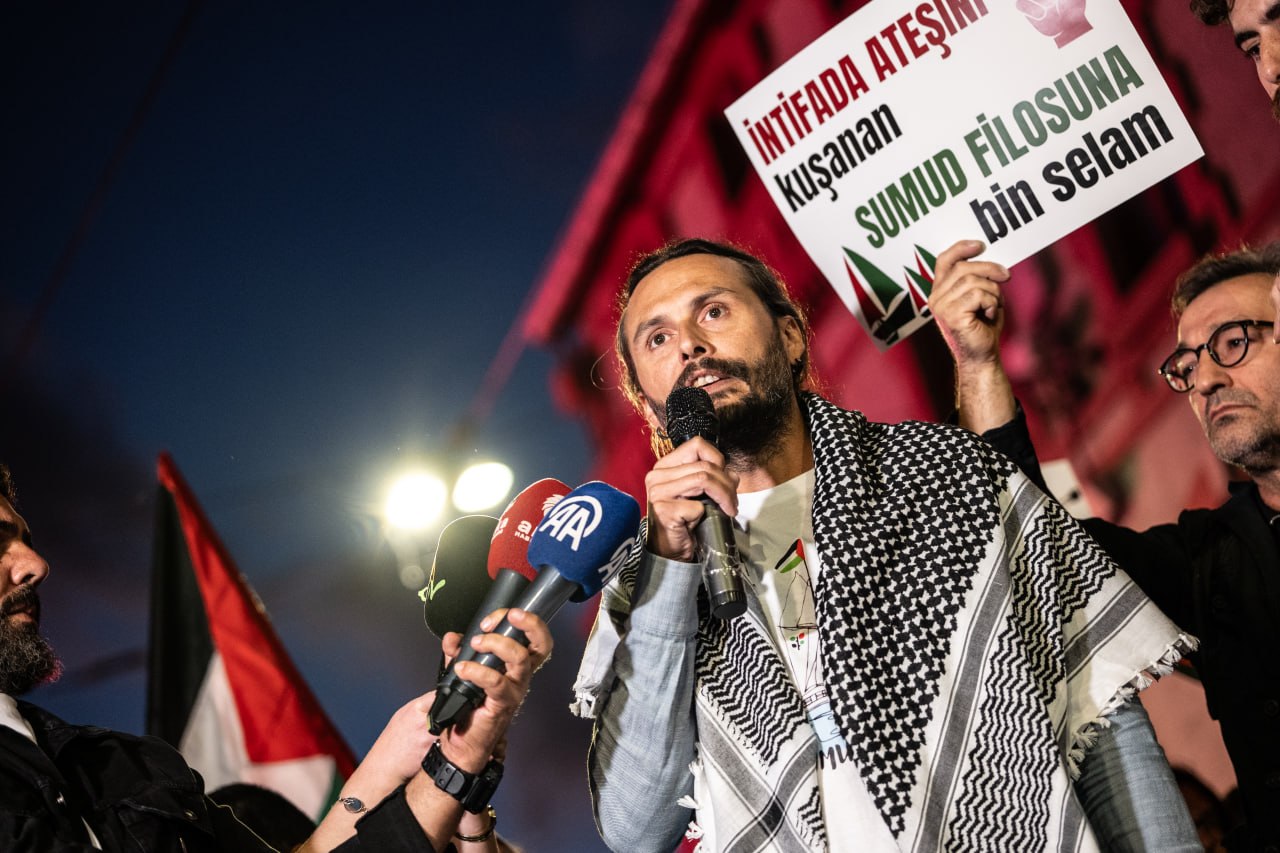
We spoke with Görkem Duru, Central Committee Member of the Workers’ Democracy Party (IDP) and member of the International Executive Committee of the International Workers’ Unity–Fourth International (IWU-FI), about his participation in the Global Sumud Flotilla and the significance of this organization for the Palestinian struggle.
You have been involved in the Global Sumud Flotilla organization for the last two years. How do you assess its significance and contribution to the Palestinian struggle? What factors led IWU-FI and IDP to politically support this organization and motivated your decision to join the flotilla?
In fact, flotilla initiatives have been organized repeatedly since 2007, when the Zionist entity’s illegal blockade of Gaza began, with the aim of breaking this blockade and ensuring the delivery of humanitarian aid to the region. Since October 7, 2023, with the transition of the Zionist entity’s genocide and occupation into a new phase, the flotilla organization has also assumed a much broader international character. The clearest indication of this is that the Global Sumud Flotilla has, for two consecutive years, succeeded in organizing itself as the largest civilian flotilla in world history.
As you mentioned, I have also been involved in the organization for the past two years. Although I was unable to board the ships that set sail for Gaza during the 2025 mission, I actively participated in the on-the-ground preparation process in Tunisia. This year, I was involved both as a member of the Campaign Coordination Group of the Global Sumud Flotilla Turkey Committee during the preparation phase and as an organizer aboard the ships that set out to break the blockade.
This is because I believe that the Global Sumud Flotilla carries multiple meanings and contributions for the Palestinian struggle. One of these is that, since October 7, 2023, it has become the largest international campaign organized around the demands of solidarity with the Palestinian struggle, breaking the blockade, delivering humanitarian aid to Gaza, and ending the occupation and genocide. Think about it: these four demands are capable of bringing together more than 500 participants from over 50 countries and from diverse political tendencies—not only those on board the ships, but also those involved in the preparation process and those who continue to support the initiative from land after the ships have departed—as part of a united action. “Building the broadest possible unity around immediate demands.” This formula is frequently invoked in revolutionary Marxist and internationalist politics. The flotilla is, in fact, one of the most concrete examples of this formula being put into practice.
“We believe that the Palestinian resistance constitutes one of the main arteries of the world’s peoples’ struggle to break free from the imperialist and capitalist system of exploitation. We therefore consider it critically important to participate in the broadest possible united action organized for this cause, to expose the policies of hypocritical capitalist governments that are complicit in these crimes, and to sustain mass mobilization.”
For me, another important aspect of the organization in relation to the Palestinian struggle is that: For more than two and a half years, we have been witnessing a genocide in real time. The primary factor enabling the Zionist entity to continue genocide and occupation is the hypocritical policies and complicity of our governments. The continuation of every kind of diplomatic, military, economic, and academic relationship with the Zionist entity and its Nazi regime inevitably results in the continuation of genocide in Palestine. It is precisely in this sense that the flotilla’s role in exposing governments’ complicity and hypocrisy, while calling on the peoples of the world to mobilize against them, is extremely important. Yes, the humanitarian and emotional dimensions of the Palestinian struggle are highly significant, but I want to emphasize this: The ongoing genocide and occupation are the result of political choices made by our capitalist governments, and for that very reason, political struggle is indispensable.
The perspective I have outlined above also constitutes the main reason why the International Workers’ Unity–Fourth International participates in the Global Sumud Flotilla. For the past two years, comrades from our Turkish section, the Workers’ Democracy Party—of which I am a member—as well as comrades from our Argentine section, Socialist Left, have actively taken part in the flotilla. Likewise, comrades from our fellow party in the State of Spain, Internationalist Struggle, and from our Brazilian fellow party, Socialist Workers’ Current, are active components of the Global Sumud Flotilla committees in their respective countries.
This is because we believe that the Palestinian resistance is at one of the central positions in the global class struggle and constitutes one of the main arteries of the world’s peoples’ struggle to break away from the imperialist and capitalist system of exploitation. We therefore consider it critically important to participate in the broadest possible united action for this cause, to expose the policies of hypocritical capitalist governments that are complicit in these crimes, and to build the instruments necessary to sustain and expand mass mobilization.
After setting sail, you were detained aboard the Zionist entity’s torture ship in international waters. Just as governments have stood by and watched the genocide for years, they also stood by and watched this happen. How do you assess this process?
To be honest, I did not personally expect governments that have remained silent for years in the face of genocide and the torture inflicted upon the Palestinian people to react seriously to the torture that we were subjected to—which, compared to what the Palestinian people are enduring, is insignificant.
When it comes to the Zionist entity, I can begin by saying that international law—which has proven ineffective in many areas—also proved ineffective in international waters. On the night of April 29, when 180 people, including myself, were abducted and 22 of our vessels were seized, the Zionist entity intervened while we were still 650 nautical miles away from Gaza, meaning that we had not yet even reached Greek territorial waters. The last intervention, which began on the night of May 18, likewise took place 350 nautical miles away from Gaza. The conclusion is clear: Zionism is once again declaring that it can engage in piracy anywhere in the Mediterranean without regard for international law. Naturally, the first question that comes to mind is this: How could the states, particularly the ones bordering the Mediterranean, not have been aware of such military activity on April 29 and May 18–19? Let me share what I personally witnessed. Approximately half an hour before our vessel, Idna (Ghea), was seized by the Zionist entity on the night of April 29, a Greek coast guard vessel passed very close to us. When we were dropped off at the NATO port in Crete on the morning of May 1, we asked the authorities there what they had been doing on the night of April 29. Their response was: “We were observing.” Observing human trafficking! This is perhaps one of the most striking examples of our governments’ complicity.
Another example of this complicity and hypocrisy occurred on the night of April 29, when all 22 vessels of the flotilla were being seized while a cargo ship carrying ammunition and supplies to sustain Zionism’s genocide passed right beside us.
There is another point I would like to emphasize. The Zionist entity fears the Global Sumud Flotilla participants more than it fears our governments. The fact that they have built a floating prison where they can torture us, the silence of governments in response to the torture inflicted on flotilla participants abducted on April 29, and the even more severe torture imposed on the comrades abducted on May 18–19… By significantly escalating the level of violence directed at flotilla participants compared to previous years, Zionism was clearly attempting to send a warning. While governments continue their relations with Zionism by remaining silent about the genocide in Palestine, what the other side fears most is the mobilization of the peoples of the world for Palestine.
“Within the framework of Trump’s fake peace plan, yet another fake ceasefire was introduced. Its purpose was to throw a lifeline to the Zionist entity at the moment of its greatest historical isolation. In a sense, the goal was to normalize genocide and occupation. Throughout this period, we in the Global Sumud Flotilla repeatedly emphasized this: we reject normalization under the guise of a fake peace plan.”
The Global Sumud Flotilla was unable to break the blockade, but it generated significant awareness. Do you believe the flotilla achieved its objectives?
Yes, perhaps we were unable to break the blockade and deliver humanitarian aid to Gaza, but I believe we had a significant impact in terms of raising awareness and helping place the Palestinian struggle back on the agenda of the peoples of the world.
Of course, when assessing this, one must not overlook changes in the political conjuncture. Before last year’s mission set sail, there was already a very powerful wave of mobilizations around the world in solidarity with Palestine. The flotilla emerged on the basis of those mobilizations and was able to give additional momentum to them. As you may recall, the working classes of Italy and the Spanish State carried out general strikes centered on Palestine, which in itself pointed to a qualitative leap in the struggle. It was precisely this escalation in mass mobilization that alarmed imperialism and the capitalist governments. After all, the masses taking to the streets in solidarity with Palestine were increasingly beginning to target their own hypocritical and complicit governments as well. As a result, they adopted a tactical shift. In order to reduce popular pressure, many capitalist governments began recognizing the State of Palestine one after another—but, of course, without severing their relations with the Zionist entity. Through a democratically reactionary tactic, they created the illusion that they were doing something for Palestine and thereby succeeded in restraining the mobilizations. Subsequently, as part of the same tactic, within the framework of Trump’s fake peace plan, yet another fake ceasefire was introduced. Its purpose was to throw a lifeline to the Zionist entity at the moment of its greatest historical isolation and to allow it to continue the genocide and occupation in a more diluted form than before the ceasefire. In a sense, the goal was to normalize genocide and occupation. Throughout this period, we in the Global Sumud Flotilla repeatedly emphasized this: “We reject normalization under the guise of a fake peace plan.”
Unfortunately, the retreat of the mobilizations and the introduction of the fake ceasefire pushed the Palestinian struggle further down the global agenda this year. In addition, the recent escalation of imperialist aggression generated a number of issues that overshadowed Palestine. These included U.S. imperialism’s intervention in Venezuela, the war launched by U.S. imperialism and Zionism against Iran, and Zionism’s occupation of Lebanon. In an effort to overcome their impasse, imperialism and Zionism attempted to paralyze the mass movement by opening new fronts in the “war”. Perhaps they achieved a certain degree of success. However, I do not believe that this escalation of aggressive policies has enabled imperialism to overcome its crisis of hegemony. That is, of course, a broader discussion for another time. Nevertheless, I believe that the 2026 mission of the Global Sumud Flotilla succeeded in bringing together public opposition to this imperialist aggression while keeping Palestine at its center. When you look at the international actions organized in solidarity with us while we were sailing toward Gaza or after we had been abducted by the Zionist entity, you can see that not only Zionism but also the policies of the United States, imperialism and capitalist governments were being exposed. Even today, Zionism continues to bomb Gaza under the label of a “ceasefire” and continues its occupation of Lebanon.
“What is even more important from our perspective is that international public opinion has increasingly begun to ask itself what Zionism is doing to the Palestinian people if it is capable of inflicting this level of torture on the participants of the Global Sumud Flotilla.”
Another factor that contributed to raising awareness was the fact that Zionism dramatically increased the level of violence directed at Global Sumud Flotilla participants compared to previous years. Videos personally shared by the genocidal Ben-Gvir, as well as the testimonies given by participants after their release, made it possible to grasp the extent of the torture. What is even more important from our perspective is that international public opinion has increasingly begun to ask itself what Zionism is doing to the Palestinian people if it is capable of inflicting this level of torture on the participants of the Global Sumud Flotilla.
Finally, I would like to add the following. One of our goals in setting sail was to expose the complicity and hypocrisy of our governments. One of the most effective ways of doing this is by revealing the economic relations that continue with the Zionist entity, and encouraging people to take action against their own governments. In this regard, while our vessels that departed from the Port of Barcelona were on their way to Italy, they exposed and staged an action near a cargo ship carrying ammunition to Zionism. Similarly, on the night before we planned to expose and protest another vessel, our flotilla was targeted by the Zionist intervention of April 29. These examples are important because one of the most effective ways of stopping the genocide and occupation and supporting the Palestinian struggle from abroad is to mobilize in our own countries for the complete severance of all relations with the Zionist entity. For example, the flotilla’s action had a positive impact, particularly among militant sectors of the working class. In Livorno, dockworkers attempted to block a ship carrying fuel to Zionism, and on May 18 the Italian working class once again went on strike with Palestine at the center of its agenda. The real challenge, however, is to expand and sustain such examples.
“The Global Sumud Flotilla is a united action that brings together participants from many different political tendencies who are concerned with the Palestinian struggle and who have agreed to act collectively around a series of immediate demands including ending the genocide and occupation, breaking the blockade and delivering humanitarian aid to Gaza.”
Sumud brought together people from different political tendencies across the world who acted together around the common goal of breaking the blockade of Gaza. Do you think the socialist movement in Turkey has made a sufficient contribution to this process? What more could be done?
As I tried to explain earlier, the Global Sumud Flotilla is a very broad unity of action. It is a united action that brings together participants from many different political tendencies who are concerned with the Palestinian struggle, actively involved in it, and who have agreed to act collectively around a series of immediate demands including ending the genocide and occupation, breaking the blockade and delivering humanitarian aid to Gaza. Participants come from trade unions, socialist parties, the feminist movement, the ecological movement, groups that embrace Islamic perspectives, advocates of liberalism, and many other sectors that I may be overlooking. All of these participants are involved in the process by making considerable personal sacrifices.
As a revolutionary Marxist from Turkey who has participated in the initiative for two consecutive years, I can say that the socialist movement and the militant trade unions have unfortunately not contributed to the process adequately. Compared to last year, more socialist groups included this year’s mission on their political agenda, which I think was a very important step forward. Likewise, comrades from other socialist parties applied to participate in this year’s flotilla. Had Zionism not intervened much earlier than we anticipated on the night of April 29—an intervention that resulted in the loss of 22 of our vessels—some of these comrades would most likely have been able to join the ships that later departed again from Marmaris. I believe this is important for enabling participation from other socialist organizations in Turkey in future possible flotilla initiatives.
“I believe that the socialist movement and the militant trade union forces in Turkey need both to keep the Palestinian struggle more prominently on the agenda and to be more attentive to the largest international united action organized for Palestine over the past two years.”
In general, however, my assessment of the place the flotilla within the agenda of the socialist movement and militant trade unions is a negative one. This is, of course, the subject of a broader political discussion, but I will try to keep my remarks brief.
From my observation, there is a political perception—which I believe is deeply mistaken—within a section of the socialist movement that participating in or supporting the flotilla somehow benefits AKP. The Global Sumud Flotilla is, in fact, an initiative that maintains its independence from all governments. For example, the fact that a particular government opens its ports to the flotilla does not make invisible that government’s ongoing diplomatic, military, economic or academic relations with the Zionist entity. Moreover, governments that open their ports generally do so under pressure from below. But even if AKP were to attempt to use the flotilla for its own benefit, that would simply become another arena of political struggle that must be pursued. After all, it is obvious that 30 percent of the Zionist entity’s energy needs pass through Turkey and that the Kürecik and İncirlik bases function as shields for Zionism.
There is another point that should be considered. The flotilla sets sail in order to break the blockade, and its most fundamental political objective is to weaken the Zionist entity. Weakening the Zionist entity is, in a direct sense, also synonymous with weakening imperialism, its accomplices and hypocritical governments.
Finally, I believe that one of the areas in which the socialist movement and militant trade union forces in Turkey are weakest is the unity of action. The flotilla is itself an example of this. The answers given to questions such as what united action is, why it should be built and how it should be organized differ so greatly that even amid the multiple crises currently affecting Turkey, a genuine unity of action cannot be built properly.
Returning to the flotilla itself, as long as the blockade of Gaza continues and as long as the genocide and occupation persist, new initiatives will undoubtedly be considered. I believe that the socialist movement and militant trade union forces in Turkey need both to keep the Palestinian struggle more prominently on the agenda and to be more attentive to the largest international united action organized for Palestine over the past two years.
“Increasing role of the international working class within this struggle is of crucial importance. Italian dockworkers have played a pioneering role in this regard. By making the Palestinian struggle their central issue, they were able to organize two general strikes last year and one this year.”
By what other means and methods should the Palestinian struggle be supported today? How can examples such as those of the Italian dockworkers become more widespread?
The most important task is to explore and discuss ways of sustaining the struggle until our complicit and hypocritical governments sever all relations with the Zionist entity and impose a full embargo upon it. Increasing the role of the international working class within this struggle is of crucial importance. As you noted, Italian dockworkers have played a pioneering role in this regard. By making the Palestinian their central issue, they were able to organize two general strikes last year and one this year. We need to understand that this was the result of the Italian Rank-and-File Trade Union Confederation consistently keeping the Palestinian question on the agenda, attempting to block ships carrying supplies to the Zionist entity in Italian ports and creating pressure on the bureaucratic trade unions. The issue is not to carry out a single action and then retreat, nor to appear only on symbolic dates related to the Palestinian struggle and disappear afterward. The issue is to make the struggle permanent.
Yes, unfortunately, the trade union movement in Turkey is not yet at this level. But it is important to remember that it is possible to start somewhere. Especially when 30 percent of the Zionist entity’s energy requirements pass through this country.
As everyone knows, this year’s flotilla included participants from Turkey at the leadership level from both Hak-İş and Memur-Sen (Union of Civil Servants) confederations, and I believe this was a very important step forward. However, every step only acquires real value if it makes the next step possible. The needs of the Palestinian struggle require broadening this mobilization at the grassroots level and, in particular, mobilizing those sectors that can play a decisive role in weakening the Zionist entity. We also know that many trade unions currently maintain active Palestine commissions. The first possible starting point that comes to mind is creating conditions under which all trade unions and professional associations that keep Palestine on their agenda and maintain such commissions can come together, regardless of confederation affiliation. Perhaps, if I reflected on it further, I might become convinced that another proposal would be even more effective. But that is precisely my point: we need to devote more thought and effort to these questions.
“The issue is not to carry out a single action and then retreat, nor to appear only on symbolic dates related to the Palestinian struggle and disappear afterward. The issue is to make the struggle permanent.”
Likewise, campus occupations at universities once served as a major driving force behind international solidarity with the Palestinian struggle. While these occupation experiences succeeded in creating lasting university coordination structures in some countries, they unfortunately faded away in many others. Nevertheless, they remain critically important examples because they demonstrated the necessity of giving the upsurge in mobilization a permanent organizational foundation.
Let me conclude by summarizing my views as follows. Until a free Palestine is achieved from the river to the sea, the tools, tactics and forms of united action may—and indeed should—change. However, the construction of a single, secular, democratic and non-racist Palestine depends upon the dismantling of the Zionist entity. And the dismantling of the Zionist entity depends upon our ability to sustain mobilization in our own countries until capitalist governments sever all ties with Zionism and impose a full embargo on Israel.
Thank you for sharing your experiences and assessments of the process.