By Miguel Sorans, a leader of Socialist Left (Argentina) and the IWU-FI
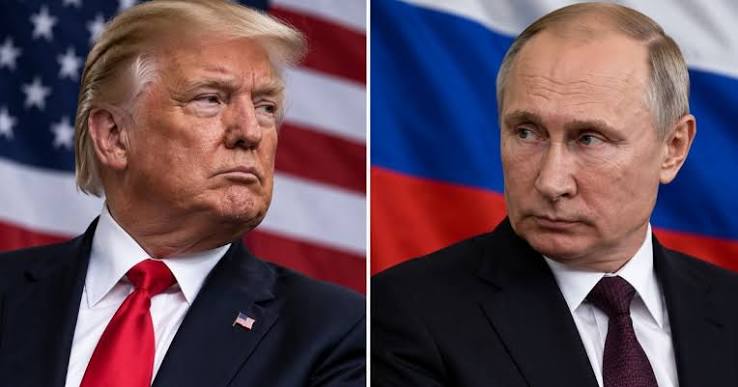
14 October 2026. Unexpectedly, on 9 October, Donald Trump announced that he had reached an agreement with Russian President Vladimir Putin to increase the supply of diesel to U.S. and global markets. He stated that this was part of an agreement for an “energy truce” in the war between Russia and Ukraine. Following a 90-minute call with Putin, Trump wrote on Truth Social that “it was agreed that Russia will immediately supply more than 300,000 tons of diesel fuel to the U.S. and global market, another 500,000 tons during the month of November, and 1,000,000 tons immediately thereafter.”
This announcement by the far-right Trump has sparked a new international political scandal. This agreement with Putin—reached amidst the war with Ukraine, now in its fourth year following Russia’s imperialist invasion—constitutes direct support for the aggressor, as it provides Russia with billions of dollars in revenue from the fuel sale.
To make matters worse, Trump did not even inform Ukrainian President Zelenskyy about the call, let alone the agreement; Zelenskyy learned of it through social media. He described it as a “birthday gift for Putin.”
In doing so, Trump has unilaterally dismantled all economic sanctions imposed on Russia. This further confirms that the leader of U.S. imperialism—since taking office in January 2025—has been openly seeking a pact with Putin. Such a pact effectively supports Putin’s goal of forcing Ukraine to surrender and cede the Donbas and Crimea—territories that are historically part of Ukraine but have been usurped and are currently under Russian military control.
Trump is now openly doing what Biden did covertly when he was president at the time of the invasion in February 2022. Back then, Biden offered Zelenskyy a plane to leave Ukraine and go into exile. As CNN reported in 2022: “Zelenskyy rejected a U.S. offer to evacuate him from the capital, Kyiv…”
“The fight is here; I need ammunition, not a ride,” Zelenskyy said (CNN, 26 February 2022). In other words, Biden was in favour of ceding Ukraine to Putin—who had announced that he would take Kyiv, the Ukrainian capital, within two weeks. It was only due to military resistance and a mass popular uprising that this did not happen. Four and a half years of war have passed, and there is no solution in sight. Neither the U.S., the European imperialist powers, nor the Vatican have ever been in favour of defeating Putin. Pope Francis, for instance, in 2024 “urged Ukrainian President Volodymyr Zelenskyy to have the ‘courage’ to raise the ‘white flag’ and negotiate an end to the war with Russia” (March 9, 2024, Infobae)—a stance that earned the late Pope well-deserved popular rejection in Ukraine.
The agreement to purchase tons of Russian diesel, combined with Trump’s pressure on Ukraine to halt its effective drone strikes against oil refineries on Russian territory, are factors that favour Russia. The war is at a stalemate, and Russia is unable to advance on the front lines. The Russian economy is deteriorating due to war expenditures, and its oil reserves are dwindling—a situation exacerbated by the blows dealt to its oil and petroleum-product production. The U.S.’s purchase of Russian diesel provides Moscow with an influx of billions of dollars, offering it some breathing room. Russia also needs Ukraine to stop bombing its refineries; hence Trump’s call for an “energy truce”—a proposal that, for now, neither Russia nor Ukraine has accepted.
However, Trump’s primary objective is to obtain a far-reaching agreement with Putin, which hinges on the surrender of Ukraine. This is why Trump has openly questioned Zelenskyy—who, for the time being, refuses to “negotiate” (which, in this context, effectively means surrendering and accepting that Putin and Russia should retain parts of Ukrainian territory). Zelenskyy knows… …like any bourgeois ruler, [he knows] that accepting such a surrender would surely spell the end of his government. Furthermore, the economic policy of Zelensky’s capitalist government—which serves major oligarchs and is rife with corruption—effectively weakens popular resistance.
Trump has gone so far as to call for elections to oust Zelensky, acting almost on behalf of Putin. He accused Zelensky of “not wanting to negotiate,” noting that the Kremlin was interested in reaching a solution that would allow for de-escalation of the conflict; he suggested that the time had come for a change in the presidency and urged Ukrainians to “find a new leader who can reach an agreement” (Clarín, Argentina, 13 October 2026).
Trump is acting in Putin’s favour, quite openly, for several reasons: 1) because the political, economic, and military crisis of U.S. imperialism has intensified, fuelled by an aggressive policy and …Trump’s colonialist agenda, and he needs to show that he is still attempting to bring an end to the war in Ukraine; 2) because Trump was defeated in his war of aggression against Iran, and one of the consequences has been a rise in oil prices—which has exacerbated the capitalist economic crisis, especially in the U.S., hurting the living standards of Americans through inflation driven by higher fuel costs; 3) because, as his popularity wanes, there is a growing risk that he could lose control of the legislative chambers in the November 3rd midterm elections—compelling him to appear as though he is taking “measures” to lower fuel prices, in this instance by purchasing tons of diesel from Putin.
All of these actions by Trump, carried out in agreement with Putin, reveal two things: 1) that U.S. imperialism—the dominant force in the capitalist world—seeks the defeat of Ukraine and its people at the hands of the aggressor, the Russian empire; and 2) that it is incorrect—as many on the Left do—to define this war as “inter-imperialist.” This has created significant confusion among segments of the anti-imperialist vanguard and the Left.
These are difficult discussions, given the widespread confusion that exists globally—compounded by the fact that many reformist leftist leaderships portray Putin and Russia as “anti-imperialist.” Russia is a capitalist, imperialist country, and Putin is a far-right dictator. The USSR no longer exists. Furthermore, Ukraine is a European bourgeois semi-colony. Russia is invading in an attempt to colonize Ukraine—much like the U.S. invades or commits acts of aggression against Iran. This is not a case of two imperialist powers fighting one another. Trump’s policy of reaching agreements with Putin demonstrates precisely this: rather than two imperialist powers on the brink of war, they are seeking an accord to carve up Ukraine between them. Trump makes it clear that he views Ukraine as a bargaining chip in the arena of imperialist powers, and that he is prepared to hand over a significant portion of Ukrainian territory to Russia—provided that Russia does not obstruct his various acts of American aggression elsewhere. This explains Putin’s abstention regarding Trump’s plan for Gaza, as well as his inaction in the face of U.S. aggression against his ally, Venezuela, and the abduction of its president, Nicolás Maduro. Trump has already compelled Ukraine to surrender some of its rare-earth mineral resources as payment for the military equipment it received.
Certainly, there are differences and clashes between the various imperialist powers—including those within the European Union (EU) and Russia. Such tensions also exist between the U.S. and the EU; indeed, Trump even attempted to acquire Greenland, which belongs to Denmark.
Many argue that “NATO is behind Zelensky, supporting the military defeat of Putin.” But this is not the case. As we have pointed out since the 2022 invasion, neither the U.S., the EU, nor NATO sought Putin’s military defeat; rather, they aimed to negotiate a partition of Ukraine. That is precisely why they never provided Ukraine with the quantity of modern weaponry it required.
For instance, it took the U.S. and European nations more than a year and a half to send a handful of tanks to Ukraine—many of which were obsolete models. Germany, for example, sent about a hundred Leopard 1A5 tanks—a model “so old that German instructors had to turn to soldiers from the Dutch and Danish armies—where the model remained in service longer—as well as to former German tank crew members who trained in the 1980s and 1990s” (Clarín, Argentina, 31 October 2023).
Ukraine’s greatest strength in its military industry lies in the production of drones, which for the past year have wreaked havoc within Russian territory. This achievement is a testament to the ingenuity and capability of Ukrainian technicians, scientists, and workers.
However, a major military weakness for Ukraine is the lack of air defences capable of stopping the modern Russian missiles that strike Kyiv and other cities on a daily basis.
The only weapons capable of stopping them are U.S.-made Patriot interceptors. Yet, Ukraine ran out of these interceptors some time ago, and they have not been replenished—a reality that many are unaware of. “A Patriot launcher sits in the middle of a cornfield, its tubes empty. It hasn’t fired in weeks—not because the system is malfunctioning, but because Kyiv is running out of interceptors” (El Nacional, Barcelona, 18 August 2023). In September, Trump mentioned the “possibility” of granting a license for Ukraine to produce Patriot systems itself; however, this could take years, as it would require establishing a complex industrial supply chain and utilizing highly specialized technology.
We believe it is a mistake to characterize both sides as equally bad. As revolutionary socialists within the IWU-FI, we neither align ourselves with NATO nor offer support to Zelensky’s bourgeois government. Instead, we support the resistance of the Ukrainian people, who for over four years have been confronting an invasion of their territory by Russian imperialism—just as we support Iran …against Trump’s aggression. But that does not mean we support the dictatorial regime of the Ayatollahs.
Following the masters of Marxism, we define this war as involving a just cause: an oppressed nation resisting an invading power—Russian imperialism—which seeks to seize a large portion of Ukrainian territory.
This is not the first time a just war has been led by counter-revolutionary forces. In 1937, Trotsky supported semi-colonial, capitalist China in its war against Japan—the imperialist invader—even though the country was ruled by Chiang Kai-Shek, a murderous, fascist dictator who had massacred thousands of workers and peasants during the insurrections and revolts of the 1920s. China received arms from Hitler’s Germany, then from U.S. imperialism, and later from the USSR. We follow those same teachings. To do otherwise would be to claim that Trotsky was wrong.
Similarly, in 1982, Nahuel Moreno and the Socialist Workers’ Party (PST) supported Argentina in the Falklands (Malvinas) War against Great Britain—a war led by a genocidal dictatorship. The rallying cry from that time remains relevant today: “The Malvinas are Argentinians.”