
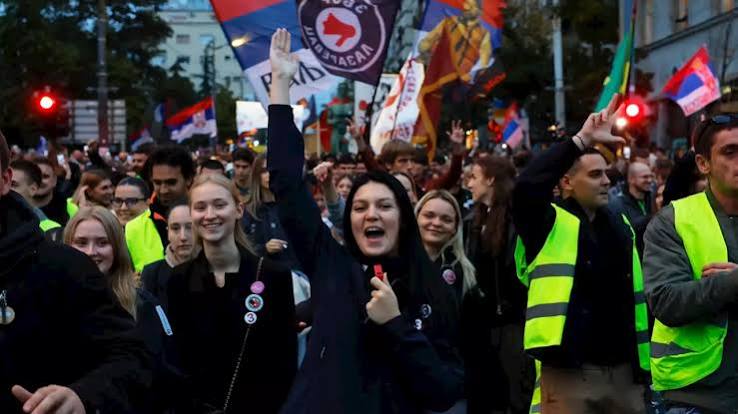
After two years of huge mobilisations, Vučić’s government suffered a heavy defeat at the polls in Serbia. In the previous elections (2023) Vučić’s alliance had won 46.75% of the vote, while the closest opposition bloc got only 23.66%. In the elections of 25 October, the Student List won 52.65% of the vote, while Vučić was held to 39.22%. Considering that Vučić used every resource of power at his disposal, the real result may well have been even more crushing.
The historic election victory in Serbia has not meant the end of the mass mobilisations. Today, people across Serbia are mobilising on a massive scale to expose corrupt officials and state representatives involved in criminal activities. At the same time, they are cleaning up parks occupied by Vučić supporters and removing the hateful slogans they had painted on the walls.
A new government is expected to be formed within 30 days of the announcement of the final results, and the Student List has a large enough majority to form the new government on its own.
The first victory was won against the traditional opposition
The masses in Serbia had been on their feet against their corrupt and repressive regime for a very long time. In this sense, their situation was quite similar to that of the rest of the world. But one feature sets Serbia apart: the mobilisation not only brought down the government but also swept away the traditional opposition establishment, preventing it from playing a role in the new period.
Throughout 2026, the students drew up their own list for the elections through university assemblies across the country and the zborovi, local bodies equivalent to a kind of people’s assembly. The university organisations were given a right of veto over controversial names. In the end, a list of 250 people was formed, made up mainly of experts (two-thirds of the list hold PhDs.). The pressure of this extraordinary organisational capacity of the masses led many opposition parties to stay out of the elections and declare their support for the Student List.
In Serbia, the mass mobilisation won its first victory against the opposition parties, before it won against the government. As far as we can see from the election results, the numerical superiority it achieved also broke other social layers away from Vučić’s alliance, layers from which he had been able to draw support in one way or another. Beyond the Serbian population, Vučić had been able to win the support of the country’s Hungarian and Bosniak populations. But the mobilisation managed to bring a significant part of the Hungarian and Bosniak population to stand against Vučić as well. In other words, Vučić lost not only the election but also the different social layers whose support he had somehow been able to secure until now.
The Student List’s 11-point programme and Vučić’s plan
During the mobilisation, the Student List published an 11-point programme. The headings of the points are as follows:
1. Independence of the judiciary
- Illegal wealth and accountability
- Transparency and oversight of public resources
- Media freedom
- Merit in the public sector
- Equal opportunity in education
- Knowledge economy and domestic production
- Job security
- Food security
- Affordable housing
- Access to health care
To briefly summarise these 11 points: removing corrupt public officials from office and bringing them to trial; identifying and confiscating the illicit gains obtained through tenders awarded under Vučić’s government, particularly in the construction sector; restoring education and healthcare as high-quality public services; amending labour legislation; breaking the grip of agricultural import lobbies and carrying out agrarian reform…
While all this sets out the most urgent needs of the people of Serbia, because of the list’s composition and structure no clear positions have been taken on certain other related problems. For example, what will replace Vučić’s plan of collaboration with imperialism in the face of a total foreign debt equal to more than half of GDP? Will only the “unjust gains” of the corrupt be confiscated, or all the wealth they accumulated through this corruption? What will be the stance towards the banks? Apart from reducing the probationary period at work from two years to one, what will be done about wages, and what rights will be won to open the way for independent trade unions?
All this will remain among the problems facing the people of Serbia in the medium term. On the other hand, Serbia’s relations with the European Union, its stance on the independence of Kosovo, and likewise the injustices suffered by the Serbian population in Kosovo, relations with the Serb Republic in Bosnia and Herzegovina and so on may emerge internationally as crisis issues in the shorter term. For now, we can assume that the only hope of Vučić and his team is to offer themselves again, when these crises break out, as a loyal and reliable ally of imperialism.
The stance of imperialism
The people of Serbia are rightly proud of their victory. For outside observers, the problems we have just outlined should not detract from the magnitude of the enormous victory achieved in Serbia. Just as the people of Serbia learned to overthrow their mafia regime and to pull the rug from under the feet of the inept establishment opposition, they will also learn, and teach, how to solve these problems.
So should we warn the masses in Serbia about a few simple matters, telling them that social injustice is growing in the EU, that the working class has been more and more exploited and impoverished since the EU was founded, that there is corruption there too, and that the EU remembers democracy only when it serves corporate profits?
The masses in Serbia have experienced the hypocrisy of Europe’s bourgeois parties better than any of us. Until yesterday these fake democrats regarded Vučić as a legitimate and proper partner, even though he was an open supporter of Putin. Above all, Vučić took on the role of the EU’s border post against migrants. As recently as 2024, a lithium agreement that will pollute Serbia’s fertile farmland was signed between the EU and Vučić. For the EU there was something in Serbia that mattered far more than democracy: reducing the entry of Chinese investment into Serbia and keeping Serbia as its own semi-colony. The demands for democracy and justice of the people living in Serbia were not even of secondary importance to the European fake democrats. That is why the two-year mobilisation received little or no attention in the Western press. The people of Serbia are more aware of this than any of us.
In the new period, EU imperialism will demand from the new administration what it used to get from Vučić, while China will likewise try to widen its room to keep up its investments. No imperialist pole, the US and Russia included, will take the slightest step to support the prosperity the people of Serbia deserve. As for Vučić, who quickly accepted his election defeat and put on a democrat’s mask, he will wait as long as he can, hoping to show at the first stumble that he is a realistic and sustainable ally for imperialism.
The possibilities in Serbia
The date on which the new government will be formed in Serbia is not yet known, and Vučić’s team will try to win as much time as it can in order to enter the new period with as little risk and as little evidence as possible. No timetable has been published either on how the government will be formed or on how its promises will be implemented.
On the other hand, the poverty the masses live in and the corruption scandals are not unique to Serbia. The capitalist crisis is so deep that nowhere in the world can the bourgeoisie find a path of accumulation that looks even relatively more humane. Every concession the bourgeoisie makes can only be won through great mass struggles.
What makes the masses in Serbia feel strongest is that they are not tied to any party. We can see that they used this in the best possible way to defeat Vučić. But in the period ahead, given the multi-class structure of the Student List, the absence of a democratic and revolutionary class party with a correct programme could become Serbia’s greatest weakness.
Perhaps for the first time since the bloody wars and break-ups of the 1990s, the people of Serbia feel united. The Student List brought together names from every part of the country. While some left-wing figures were included, religious names from the right were also on the list. The list appears to have won majority support from almost every section of the country except the Albanian population. Uniting against a mafia-like regime steeped in corruption has been the greatest strength of the people of Serbia. From now on, the people of Serbia hope to reach a future worthy of human dignity by entrusting expert professors in each field with solving the problems.
In Serbia too, as everywhere in the world until now, the masses are learning by experience and teaching us as well. The difficulties they face will bring all the contradictions to the surface in the coming period. Vučić’s rout, as he accepted defeat, is an important gain not only for Serbia but for the masses fighting against all repressive regimes in the world and all their representatives, Trump and Putin included. For Serbia, it opens up – at last – great possibilities in the search for how the problems can be solved.
The multi-class structure of the Student List will be one of the first problems it faces. The legacy trade unions from the Yugoslav era remain closely tied to the regime. This, together with the weakness of the independent unions, made it hard for the working class to enter the mobilisation with its own organisations and representatives. But we must not forget that revolutions and their vanguards do not emerge from the conditions of our dreams or to order. They emerge from the concrete struggles and mass mobilisations that exist. We support the mass mobilisation in Serbia! We support the expropriation of the wealth of everyone involved in corruption and its democratic management! We stand with the struggle of the people of Serbia to receive all services, such as education and health, as quality public services! We stand for unlimited freedom of trade union organisation for the development of an independent workers’ movement!
Eighty years ago, their partisan grandmothers and grandfathers moved to a planned economy by seizing the property of everyone who had collaborated with Nazism in their country. Not only does the Student List have no aim of moving to a planned economy, it also includes many names who would directly oppose this idea. But thanks to the mobilisation, the possibilities have grown for building a democratic party that defends a workers’ government and aims at the independence of the class.
This great victory, won first against the establishment opposition and then against Vučić, may go down in history as an important step towards re-establishing a planned economy in Serbia, and in a fully democratic form.
Chronology of two years of social mobilisation in Serbia
On 1 November 2024 a tragic accident at Novi Sad railway station killed 16 people. The protests that began after the disaster quickly went beyond the demand that those responsible be held to account and spread across the whole country.
On 22 November, after students protesting in front of the Faculty of Dramatic Arts in Belgrade were attacked, students began boycotting their faculties. The faculty boycotts soon spread to the University of Belgrade and to the universities of Novi Sad, Niš, Kragujevac and others. From this point on, the mobilisation became a huge student mobilisation. In the process, local organisations were formed at the universities.
On 22 December, a rally of more than 100,000 people took place in Slavija Square in Belgrade.
On 28 January 2025 Prime Minister Miloš Vučević resigned. In February and March, demonstrations of hundreds of thousands of people followed one after another in Novi Sad, Kragujevac and Niš.
On 15 March 2025 a huge rally took place in Belgrade. With this rally, attended by an estimated 300,000 people, the mobilisation far exceeded even the mass scale of 2000 that brought down Milošević. The impact of the rally was not limited to a single day. Students began organising marches and bicycle tours to different regions of the country, building direct links with local people. This process later expanded, through different experiences, into the “A Student in Every Village” initiative and the zborovi, that is, local people’s assemblies.
The protest on 24 March, the anniversary of the NATO bombing, laid bare how rotten the regime is in every respect. This time the centre of the demonstrations was the former Yugoslav General Staff (Generalštab) building. The building, badly damaged in the 1999 NATO bombing and granted cultural heritage status in 2005, was opened up to a luxury hotel, housing and commercial complex project by a company linked to Trump’s son-in-law Jared Kushner after the regime lifted its protected status in 2024. Students and the public opposed this decision. When, despite the protests, Vučić’s team passed a special law for the demolition and the new project, on 11 November thousands of people surrounded the Yugoslav General Staff building, forming a “living wall”; students and citizens declared that they would not allow the building to be demolished. Finally, on 16 December 2025 the Kushner-linked company announced that it was withdrawing from the project.
On 5 May the students demanded early elections for the first time.
On 9 September 2026 Vučić called early elections.
On 10 September the students launched their election campaign at a protest in Novi Sad. On 14 September the Student List was published. On 15 September the signatures needed to run in the elections as an alliance were collected. Wanting to look democratic to the world in the face of all this pressure, Vučić resigned from the presidency on 28 September in order to take part in the elections as an ordinary citizen.
Vučić’s government, which exerted heavy pressure on the press and used public resources to the full, suffered a heavy defeat in the elections held on 25 October, after 14 years in power.