By IWU-FI Press – 24 June 2026
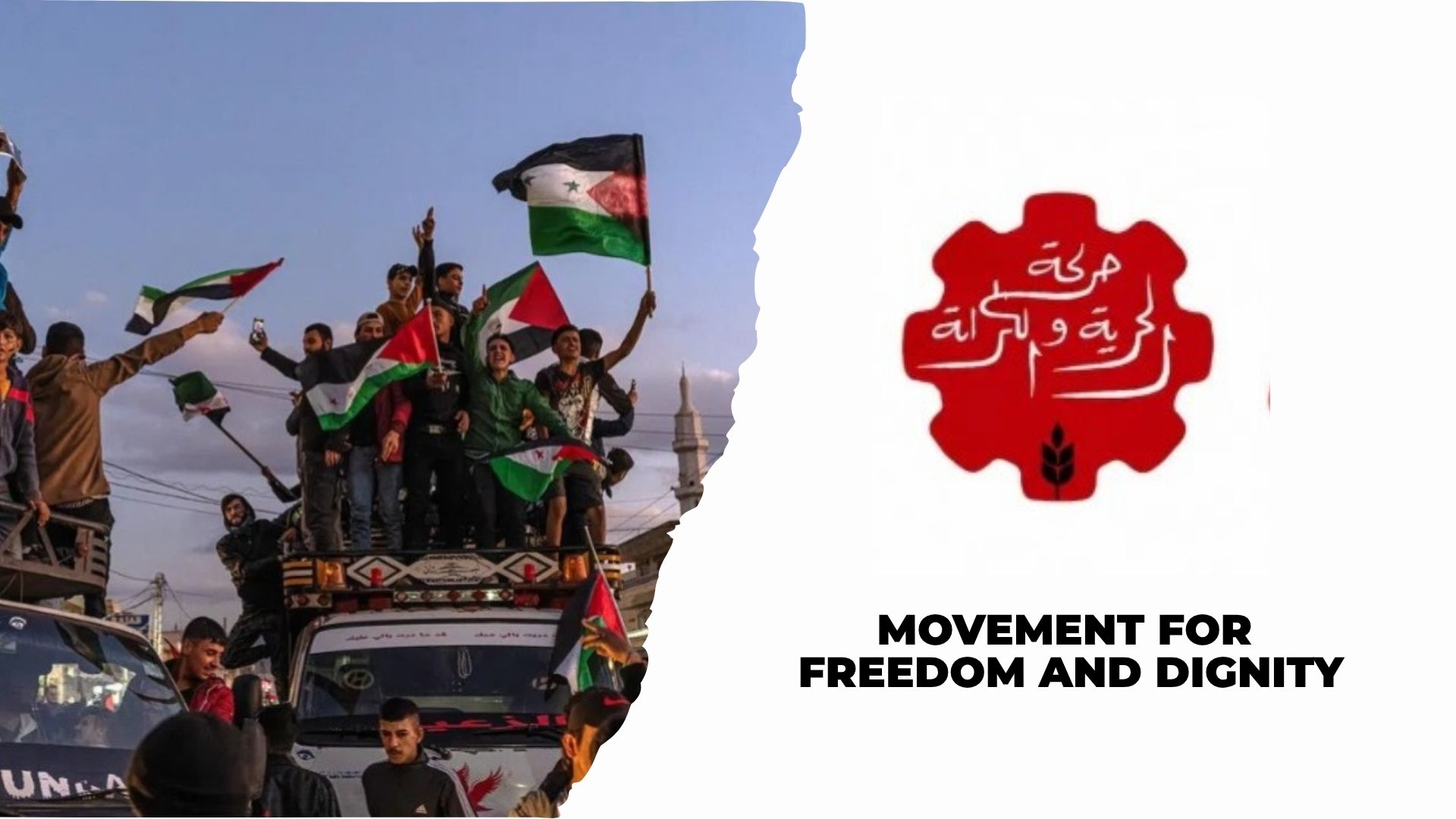
We are publishing the Political Action Programme for Syria issued by the newly formed Movement for Freedom and Dignity, an organisation seeking to intervene in the country’s evolving political landscape. Following the overthrow of the Assad dictatorship—a historic victory for the Syrian people—and amid the pro-imperialist policies pursued by Ahmed al-Sharaa’s transitional administration, the central demands of the Syrian Revolution, namely freedom and dignity for working people, remain unfulfilled.
The International Workers’ Unity – Fourth International (IWU-FI) supports this initiative, which seeks to unite revolutionary forces in Syria and across the Middle East around an emergency economic programme capable of addressing the urgent needs of the Syrian working class while defending the democratic rights of all peoples and women. Its longer-term objective is the establishment of a workers’ government that can revive the struggle for a socialist Syria founded on workers’ democracy and internationalism.
Movement for Freedom and Dignity – Syria
On 8 December 2024, the Assad dictatorship, after 54 years of authoritarian rule, finally came to an end. This marked a historic turning point not only for Syria but for the wider region. We regard this development as part of the revolutionary wave that began in North Africa and the Middle East in 2010 and ultimately gave rise to the Syrian Revolution.
The revolutionary mobilisation that erupted in March 2011 under the slogans “Freedom and Dignity” and “The people want the fall of the regime” was brutally crushed by Assad and his allies, including Russia, Iran and Hezbollah.
The inability of those allies to continue propping up the regime with the same level of support exposed Assad’s government for what it truly was: a paper tiger. A system sustained for years through external backing collapsed after little more than a week of military confrontation, demonstrating its profound fragility. Its downfall therefore represents a significant victory for both the Syrian people and the peoples of the wider region.
The regime’s collapse has ushered in a new political phase marked by both opportunities and serious dangers. The release of hundreds of thousands of political prisoners, the closure of torture centres masquerading as prisons, the re-emergence of freedoms of expression and organisation, and the reopening of political space for opposition forces and exiles all constitute important gains won through years of struggle.
At the same time, the incomplete reconstruction of the former state apparatus has left the interim authorities institutionally weak and created space for broader political intervention.
The greatest danger facing this new period is that power has been assumed by a transitional government that does not embody the aspirations of the revolution. The administration led by Ahmed al-Sharaa has prioritised rebuilding the capitalist state that previously guaranteed repression and exploitation while seeking to entrench its own long-term dominance.
To that end, it has promoted what critics describe as a tightly controlled “national dialogue” and an electoral process designed to consolidate its authority while excluding alternative political forces and failing to recognise Syria’s national and religious diversity. Rather than relying on broad democratic legitimacy, it seeks to maintain its position through military power and external backing while exploiting the sectarian and ethnic divisions inherited from the previous regime.
For these reasons, no confidence should be placed in the transitional authorities to deliver the demands for freedom and dignity for which the Syrian people have paid such a heavy price. Those objectives can only be achieved through the independent mobilisation and political struggle of Syria’s working people and can become lasting realities only under a government based on workers and the popular classes.
Such mobilisation requires Syria’s workers and oppressed communities to become active political subjects in their own right by organising independently and advancing their own demands. If the country’s future is to be determined by its people rather than by a self-appointed minority, revolutionaries must work to strengthen these movements and help build a political organisation capable of representing the historic and immediate interests of workers and all oppressed sectors of Syrian society.
Accordingly, we argue for the broadest possible unity among Syria’s revolutionary forces around a political programme rooted in the urgent needs of workers and all exploited and oppressed people. Such unity would represent the first step towards constructing a revolutionary party capable of advancing the genuine objectives of the revolution and leading a decisive break with the structures of repression and exploitation. Revolutionaries and activists throughout the country are invited to debate this programme, join the Movement and participate in the collective effort to build that revolutionary alternative.
Democratic Rights and Freedoms
The transitional government is seeking to consolidate its authority by deriving legitimacy from a self-appointed “Victory Conference” and from a parliament established through elections conducted entirely under its own control, in which only around 6,000 individuals are entitled to vote. Through this process, it aims to institutionalise an authoritarian system by drafting a constitution that excludes other political parties and currents while failing to recognise Syria’s ethnic, national and religious diversity.
The future of a people who overthrew a dictatorship at enormous cost in the name of freedom cannot be dictated by the arbitrary preferences or political limits imposed by the al-Sharaa administration. All restrictions on democratic rights and freedom of organisation must be lifted immediately, and a new constitution should be drafted through the broadest possible participation of the Syrian people.
An end to all obstacles to freedom of expression and organisation. Political parties and trade unions must be free to organise without interference. The cultural and democratic rights of every national and religious minority should be recognised immediately and guaranteed constitutionally. The struggle must be for a free and sovereign Constituent Assembly capable of securing full democratic rights and liberties for all.
Transitional Justice – Now
The Assad regime’s decades of repression and mass violence left behind a legacy of devastation in which approximately one million people lost their lives, hundreds of thousands disappeared, and millions were forced from their homes. Bringing those responsible to justice, conducting effective investigations into the fate of the disappeared, and ensuring accountability for all victims are among the most urgent demands facing Syrian society.
Yet during its time in office, the transitional government has taken no meaningful steps in this direction. On the contrary, the massacres that took place on the coast in March and in Suwayda in July have made the demand for justice even more pressing. The continued failure to establish a credible process of transitional justice has fuelled revenge killings and contributed to an ongoing cycle of violence. Since the fall of the previous regime, a significant proportion of violent incidents have taken the form of acts of retaliatory justice carried out outside any legal framework.
Responsibility for this situation lies primarily with the transitional authorities, which have failed even to establish an effective judicial system under their own administration. To guarantee justice without delay, independent commissions should be created outside government control, composed of respected legal experts, human rights defenders and other trusted public figures, and vested with genuine investigative and enforcement powers.
Working alongside popular juries, these bodies should conduct swift and effective investigations, prosecute war criminals, establish the fate of the disappeared, and initiate comprehensive programmes of material and moral compensation for those who have suffered loss and abuse.
Unconditional Recognition of Syria’s National and Religious Diversity
Throughout its history, Syria has been home to a rich mosaic of cultures, national communities and religious traditions. Any political force aspiring to govern the country should regard recognition of this diversity as a fundamental principle. Instead, successive governments have sought to consolidate their rule by encouraging sectarian and national divisions and by setting communities against one another.
This strategy, pursued to its extreme under Assad’s dictatorship, is now being reproduced in a different form by the transitional government. By portraying itself as the exclusive protector of the Sunni Arab majority while presenting national and religious minorities as potential threats, it seeks to strengthen its own authority through fear and division.
Such a strategy serves only to entrench authoritarian rule by encouraging working people to confront one another rather than the structures of exploitation they share. Opposing this approach is therefore one of the defining political tasks facing Syria today.
The country’s multinational and multi-ethnic character must be formally recognised without delay. Discriminatory and sectarian policies should be abolished and treated as violations of democratic principles. The Kurdish people’s full democratic rights—including the right to determine freely their own political status—must be recognised and guaranteed. These rights should not depend on agreements between former military leaderships and the transitional government but on the direct recognition of the Kurdish people’s democratic aspirations.
Likewise, the people of Suwayda should enjoy the right to meaningful administrative decentralisation, enabling local communities to recover control over their own decision-making processes independently of external agendas while safeguarding their political and democratic rights.
Economic Reconstruction
The Assad regime bequeathed to Syria not only a humanitarian catastrophe but also an economy in ruins. Spiralling living costs, widespread unemployment and poverty wages have made it impossible for millions to meet even their most basic needs. Confronting this economic disaster, alongside securing democratic rights, constitutes one of the central challenges of the new era. As encapsulated in the revolutionary slogan “Freedom and Dignity”, the struggle for political liberty and the struggle for social justice are inseparable.
The transitional government promises economic recovery by presenting itself as a “moderate” and “reliable” partner to regional monarchies and dictatorships, the imperialist powers, Zionism and domestic business elites. Its strategy relies on the lifting of sanctions, attracting foreign investment and generating revenue through privatisation. In practice, however, this approach has produced few tangible results and remains little more than an aspiration.
Even if fully implemented, such a programme would merely transform Syria into a semi-colony subordinated to Western imperialism and regional powers. The country’s wealth would be plundered by domestic and international capital while workers remained trapped in low-paid employment, with little prospect of any meaningful improvement in the living conditions of a population already suffering acute poverty.
The urgent needs of the Syrian people, who have sacrificed enormously in pursuit of freedom and dignity, demand a fundamentally different economic programme. Such a programme must begin not with the interests of global power politics, imperialist dictates or the demands of oligarchic elites, but with the immediate requirements of working people themselves. Those who dismiss this approach as “unrealistic” or “adventurist” are measuring reality not by the conditions endured by ordinary Syrians but by the priorities imposed by international capital and imperialist interests.
We reject that framework. The country’s resources should be mobilised immediately to satisfy the pressing needs of working people. All domestic assets belonging to the Assad oligarchy should be nationalised without compensation, while wealth transferred abroad should be recovered and returned to Syria. Debts owed to Russia and Iran, whose governments bear significant responsibility for the country’s destruction, should be cancelled, and the assets of companies linked to those states confiscated. Public debts incurred under the Assad regime should likewise be repudiated.
The tax burden should fall not on workers and the poor but on the wealthy through progressive taxation on accumulated fortunes. Resources obtained in this way should be allocated through democratic central planning to guarantee housing, food, transport, healthcare and education.
Agricultural reconstruction must become a strategic priority. Poor farmers should receive direct support, land should be redistributed to those without it or with insufficient holdings, state-owned farmland should be managed under local democratic control, and large capitalist agricultural estates should be nationalised under workers’ supervision.
An emergency public programme should be launched to provide housing for displaced families and for those whose homes have been destroyed. To ensure the rapid and effective implementation of this reconstruction effort, the banking and financial system should be brought into public ownership and incorporated into an overall national economic plan.
Oil and natural gas resources should remain entirely in public hands and be exploited for the benefit of society rather than private profit. Wages should be raised immediately to a level that guarantees every worker a dignified standard of living.
The Struggle Against Imperialism and Zionism
While employing anti-imperialist rhetoric, the Assad regime effectively turned Syria into a semi-colony dependent on Russia and Iran. In reality, it never engaged in any serious confrontation with the US or Western imperialism. It supported the American occupation of Iraq and, most significantly, accepted Israel’s continued occupation of the Golan Heights, effectively acting as the guardian of the northern frontier of the Zionist state, widely regarded as imperialism’s principal outpost in the region.
The transitional government, meanwhile, has done little more than offer excuses for its failure to restore Syria’s national sovereignty or secure the withdrawal of foreign military forces. Citing the exhaustion of the population after years of war and the country’s military weakness, it has remained silent as Israeli occupation has expanded in the south. Equally, it has failed to challenge Turkey’s military presence in the north, the continuing deployment and operations of United States forces, or Russia’s ongoing military bases along the Mediterranean coast.
We maintain that Syria’s vulnerability to foreign intervention is not fundamentally a military or technical issue but a political one. Foreign policy is inseparable from domestic policy. A government that rules through sectarian divisions and lacks the democratic legitimacy conferred by broad popular support cannot credibly defend national sovereignty against external powers. A government unable to reconcile with the people of Suwayda or with the Kurdish population, and incapable of winning their confidence, is equally incapable of mounting meaningful resistance to foreign occupation.
Accordingly, the principal obstacle to ending military occupations is neither war fatigue nor technological inferiority, but the transitional government’s own anti-democratic and sectarian policies.
We reject any political justification for acquiescing in the continued foreign military presence on Syrian territory. All foreign armed forces should withdraw immediately and unconditionally, and every foreign military base must be dismantled.
As long as the genocidal Zionist state continues to exist, lasting peace and stability for the peoples of the region will remain unattainable. Genuine coexistence cannot be achieved with a state established as a colonial project designed to dominate the region’s peoples in the interests of imperialism. Israel must withdraw from all occupied territories, including the Golan Heights.
We stand unequivocally with the Palestinian people in their resistance against genocide and occupation, affirming their right to freedom, justice and self-determination.
Women’s Rights and the Struggle for Gender Equality
The recognition and effective implementation of gender equality and women’s rights in every sphere of public and private life constitute one of the defining struggles of the present period. We reject patriarchal structures that deny women full individuality and equality by reducing them solely to roles within the family. Discriminatory laws and practices inherited from the Assad era must be abolished, and concrete measures introduced to guarantee women’s unrestricted participation in all aspects of social, economic and political life.
As a first step, civil legislation should be comprehensively reformed to establish full legal equality between women and men. Mothers must enjoy the unconditional right to pass their nationality to their children, and practical mechanisms—including gender quotas where appropriate—should be introduced to ensure women’s meaningful representation within political institutions and public administration.
Domestic violence, gender-based violence and every patriarchal practice that limits women’s emancipation or participation in society must be actively confronted. An independent investigative commission with genuine executive powers should be established to examine cases involving the abduction or disappearance of women and to ensure that those responsible are held fully accountable.
Legislation addressing violence, harassment and discrimination should be drafted with the direct participation of women’s organisations, while comprehensive reporting systems, legal protections and support services should be made available to survivors.
Social justice also requires complete equality in pay and employment rights across both industry and agriculture. Women and men must enjoy equal opportunities, equal remuneration and equal treatment throughout working life.
For the Construction of a Revolutionary Party and a Government of Workers and the People
There are persistent attempts to reduce Syrian politics to a false choice between the former Assad regime and the current transitional government. This is a misleading dichotomy. Syria’s political landscape is far more complex, and the aspirations that inspired the revolution cannot be fulfilled by either of these alternatives.
Rejecting this false binary, we maintain that achieving the revolution’s demands for freedom and dignity requires the construction of an independent political alternative, separate both from the al-Sharaa government and from the country’s capitalist elites. The objective should be the establishment of a government based on workers and the people, brought about through the creation of a political party capable of representing, in an inseparable manner, the democratic and socio-economic aspirations of Syria’s working classes.
The Assad regime sought to legitimise its dictatorship not only through a supposed anti-imperialist discourse but also by appropriating the language and symbols of socialism and the political left. Left-wing organisations that supported the regime—whether conditionally or unconditionally, including the Syrian Communist Party—helped reinforce this illusion and, in doing so, betrayed the principles of socialism.
The regime’s system of crony capitalism bore no genuine relationship to socialism or to the emancipatory traditions of the left. Socialism, properly understood, is the project of building a classless society free from exploitation and oppression, in which wage labour is no longer a mechanism of domination. It can only emerge through a decisive break with systems of repression and exploitation, relying on the democratic self-organisation of working people and on governments genuinely accountable to workers and the popular classes.
We therefore reject attempts by the Assad regime and its supporters to equate socialism with an authoritarian model of state capitalism. Instead, we reaffirm that authentic socialism is inseparable from workers’ democracy, popular participation and internationalism.
Movement for Freedom and Dignity
June 2026