By the International Workers’ Unity–Fourth International (IWU-FI)
26 November 2026. On 22 October —four days after four Salvadoran soldiers, members of the UN-backed Gang Suppression Force (GSF), were reported missing following an ambush—the right-wing, pro-U.S. dictator Nayib Bukele launched a new military intervention in Haiti by deploying 2,000 soldiers. This intervention adds to the GSF’s presence and the mercenary operations of Vectus Global—a company owned by U.S. tycoon Erik Prince, which has taken control of Haiti’s customs services. All three forms of intervention are backed by U.S. imperialist power, though there are nuances regarding how they are executed.
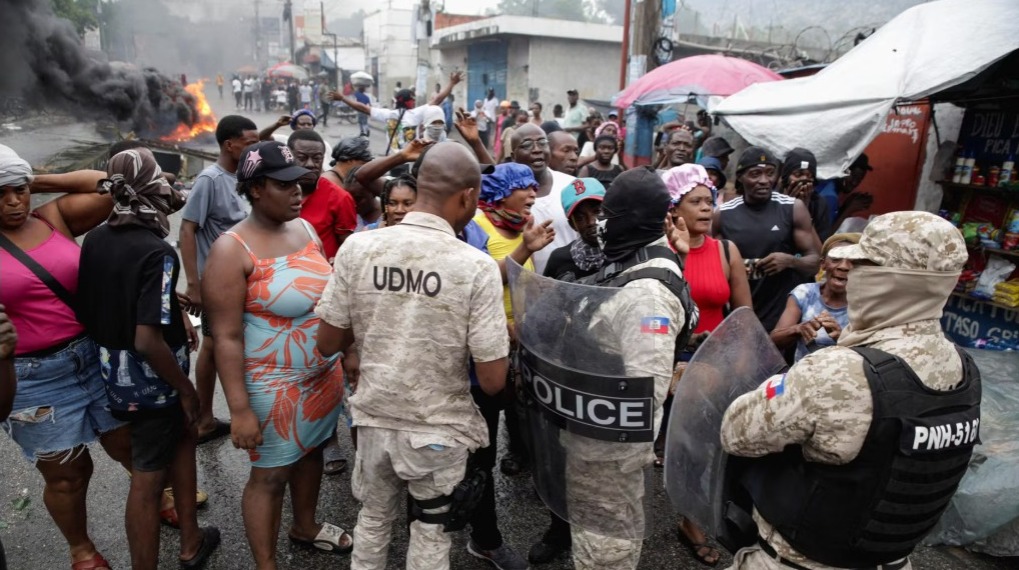
Driven by desperation in the face of the encroaching, mafia-led, counter-revolutionary “dual power” wielded by gangs, some segments of the Haitian population have pinned their hopes on this new military intervention by the corrupt Salvadoran dictatorship—with some even marching in support of Bukele. While we understand the desperation felt by much of the Haitian people, we must warn that nothing good can come from a criminal dictatorship—an ally of both Trump and Israel—that has committed massive human rights violations in El Salvador. The military of that Central American nation has a long record of crimes, both from the civil war that ended three decades ago and, more recently, under Bukele’s “state of exception.”
It is essential to recall the history of past military interventions in Haiti, including the 2004 U.S. incursion and the MINUSTAH occupation that lasted from 2004 to 2017. Both MINUSTAH and the Kenyan-led GSF forces have been accused by social organizations of committing sexual abuse against women and minors. MINUSTAH killed thousands by introducing cholera into the country. The UN never paid reparations for these crimes against the Haitian people and, together with the OAS, is responsible for imposing the right-wing PHTK regime—a regime allied with gangs and drug traffickers. This intervention contributed decisively to the current crisis.
The intervention by the Multinational Security Support (MSS) mission has exacerbated the violence. The UN High Commissioner for Human Rights reported that between January and October 31, 2026, at least 4,595 people were killed or injured amidst the violence; of these, more than 500 were reportedly killed by security forces between July and September. Furthermore, hundreds of people were kidnapped, and over a thousand women and girls were subjected to sexual violence.
Bukele had been expressing his intention to invade Haiti long before the incident in Croix-des-Bouquets. On 10 March 2024, he stated on the platform X: “We can fix it. But we will need a UN Security Council resolution, the consent of the host country, and for all mission expenses to be covered.” Bukele is attempting to market his military services—essentially as a mercenary—not out of concern for the fate of the Haitian people, but because he maintains an oversized and costly repressive apparatus amidst a prolonged economic crisis, and downsizing it would be politically problematic. For the same reason, he is renting out his maximum-security prison, CECOT, to the United States to hold migrants in illegal detention.
After Bukele unilaterally decided to send a contingent outside the framework of the MSS—in which Salvadoran troops were already present—the United States exerted pressure on the dictator to bring his actions into alignment with that coalition. On November 17, Haiti’s puppet government claimed to have signed a secret agreement with El Salvador regarding the intervention, attempting to provide a veneer of legality to the Salvadoran military presence. While Bukele states that the intervention will conclude once the missing soldiers are located, Haitian authorities seek to extend the deployment—a clear illustration of the chaotic, semi-colonial situation to which Haiti has been subjected.
Bukele is part of the right-wing, pro-U.S. alliance known as the “Shield of the Americas”. The racist Dominican government has supported Bukele’s actions; it is therefore important to highlight the complicity of both the Dominican regime and the United States with the gangs. Despite a UN embargo on arms and ammunition to Haiti, the Dominican Republic serves as a transit point for weapons and ammunition arriving from the U.S.; furthermore, members of the Dominican National Police and the armed forces have sold ammunition to Haitian gangs. In November 2024, the Dominican Public Prosecutor’s Office announced the arrest of nine police officers and one civilian—all Dominican nationals—accused of stealing over 900,000 rounds of ammunition from the National Police and selling them to gangs in Haiti. A report by the UN Panel of Experts confirms that these munitions were primarily used by the 400 Mawozo gang and other gangs operating in Bel-Air (downtown Port-au-Prince).
Bukele wants to portray himself as an expert in gang suppression. But according to journalistic investigations conducted in El Salvador, Bukele first made a pact with Salvadoran gangs, who helped him win the elections, and then betrayed his gang partners and proceeded to carry out mass and arbitrary arrests: anyone could be imprisoned based on an anonymous tip or a mere suspicion of “collaborating with the gangs.” Now, the regime wants to release almost half of the prisoners, implicitly acknowledging the arbitrariness of their detentions. This approach cannot be applied in Haiti.
In response to allegations from an organization in Haiti that Salvadoran forces had used bombs against civilians near Port-au-Prince, Bukele categorically denied it. Then, on November 10, Bukele himself celebrated having bombed a mansion belonging to Lanmò San Jou. Bukele is using images of his military actions to boost his image ahead of the upcoming elections in El Salvador, claiming that the troops will withdraw once they find the four missing soldiers.
Certainly, the gang leaders are experiencing difficulties for the first time following the intervention of Salvadoran soldiers. Notably, Wilson “Lanmò San Jou” of the 400 Mawozo requested UN mediation. But the only way forward for the Haitian people is to organize their self-defense, calling for solidarity from other nations. This is about recapturing the spirit of the Battle of Vertières, in which the liberating army defeated the French empire in 1803, and shaking off foreign occupations and the power of the mafias.
We support the struggle for a free and prosperous Haiti, without gangs or invading troops, that collects reparations from France and the US, and in which the Haitian people themselves decide their own destiny.
International Workers’ Unity-Fourth International (IWU-FI)