By Ezequiel Peressini, a leader of the IWU-FI and the Socialist Left of Argentina
3 August 2026. In the Pakistani-controlled portion of Kashmir, known as Azad Kashmir, massive mobilisations have taken to the streets since June, confronting repression that has left dozens dead in an open struggle for social and democratic rights. This new and exemplary struggle resumes the fight for independence and autonomy in the Indian subcontinent, which has suffered colonial oppression from Pakistan, India, and China, in alliance with imperialist powers, since 1949.
The fight for bread, wages, and access to basic services is gaining momentum, and new and powerful Kashmiri organisations are emerging, while the Pakistani government of Shehbaz Sharif uses bullets to repress and elections to defuse the immediate and historical demands of a people with a long tradition of struggle against oppression.
A protracted conflict that tramples on the rights of the Kashmiri people
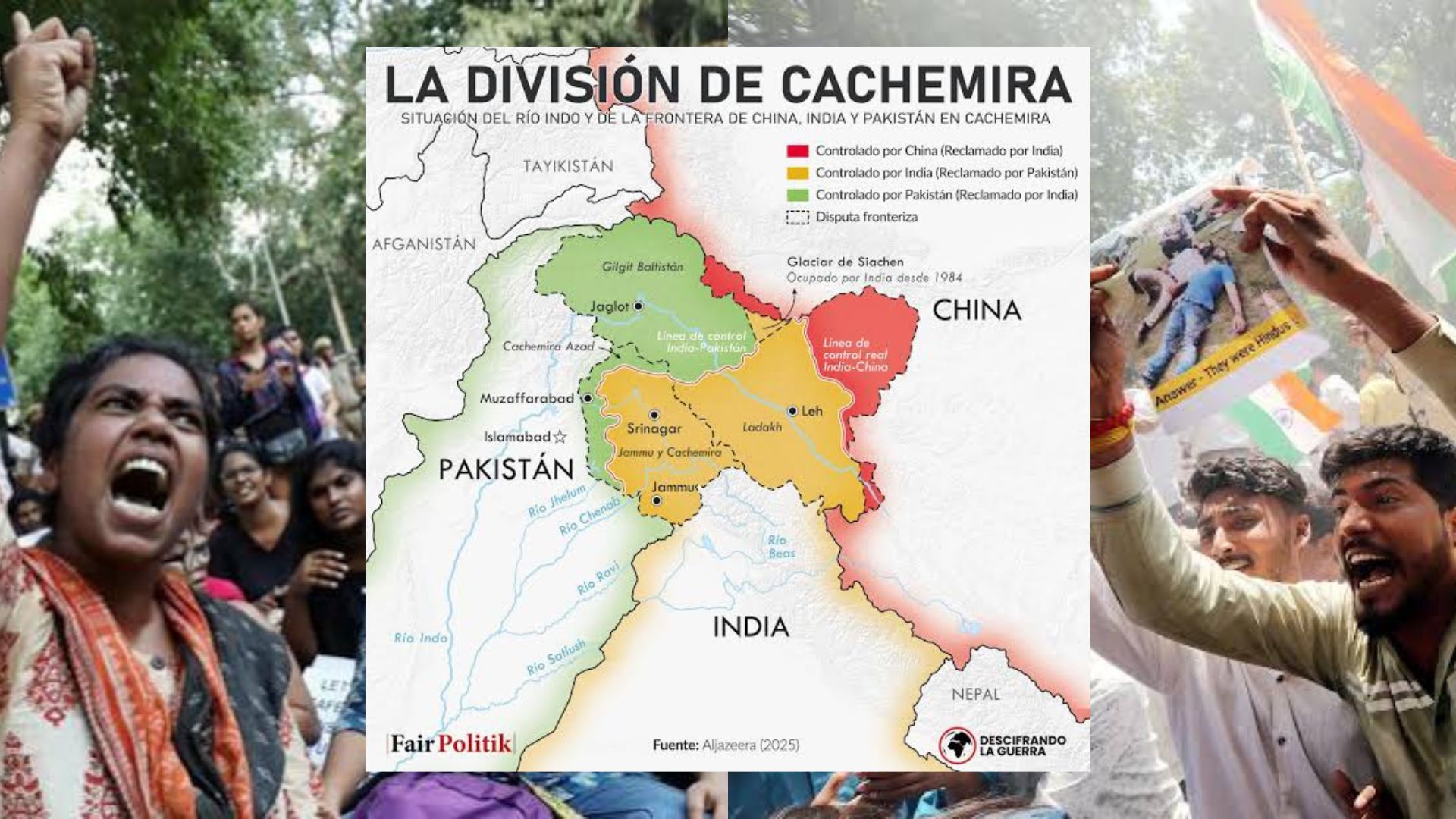
After the great triumph of India’s independence from British imperialism in 1947, the independence of Kashmir remained unresolved. Kashmir is a fertile valley located at the western foothills of the Himalayas, north of India and Pakistan, and southwest of China. The UK established borders in India based on religion prior to their withdrawal: this led to the creation of Hindu-majority India and Muslim-majority Pakistan, which was then split into West and East Pakistan; East Pakistan later became Bangladesh in 1971. Kashmir was a principality for 100 years. When India gained its independence, Maharaja Hari Singh, who ruled the principality, joined the newly formed India in exchange for its cooperation with the kingdom in countering a Pakistani attempt to control the territory. The Maharaja’s decision, as a Hindu, disregarded the Muslim majority in the territory, which, far from resolving the conflict, opened the door to further disputes. To impose a resolution to the conflict, the UN established a ceasefire in 1949 and the Line of Control, which divided Kashmir into three parts: 45 percent for India, 35 percent for Pakistan, and 20 percent for China, consisting of a vast salt desert.
Kashmir remains, to this day, fragmented into three colonially controlled regions. Pakistan controls Azad Kashmir and Gilgit-Baltistan, India controls Jammu Kashmir and Ladakh, and China controls the Akasai Chin salt flats and the Shakgan Valley. This artificial fragmentation has led to numerous and recurring military clashes between the three countries, bringing tensions to a peak, especially given that India, Pakistan, and China are all nuclear-armed and among the most populous countries in the world.
Azad Kashmir and the Rise of the Jammu and Kashmir Joint Action Committee (JAAC)
Azad Kashmir is home to approximately 3 million people, with over 1.8 million residing and working abroad. Since 2022, social, democratic, and autonomy demands unify and find expression in large-scale mobilisations to confront inflation, the cost of services, and the declining quality of life. These mobilisations seek an alternative that reclaims territorial sovereignty and natural resources.
In August 2022, the People’s Rights Movement (Awami Huqooq Tehreek) emerged, weaving together urgent social demands into a centralized platform. In May 2023, significant and massive protests took place, including demonstrations, sit-ins, and strikes with blockades, against the abuses of the Pakistani federal government from its capital, Islamabad, and the centralized puppet local government in Muzaffarabad.
During September 2023, the Awami Joint Action Committee (JAAC) emerged, and with the participation of the People’s Rights Movement, broadened its scope to include wider sectors of Azad Kashmir society. The JAAC spearheaded the creation of a provisional leadership for the movement, composed of 30 people—three from each of Azad Kashmir’s ten districts. This leadership included nationalist activists, small business owners, and members of leftist and student organisations that identified as socialist, such as the Jammu and Kashmir National Student Federation (JKNSF).
The movement’s demands included guaranteed access to hydroelectric power
The demands included reducing the cost of electricity production and abolishing unfair taxes, restoring wheat subsidies, and eliminating the privileges of the ruling elite. Following a large-scale mobilisation that swept through various localities, the government agreed to address the demands, approving a price for electricity of between 3 and 6 rupees per unit and a reduction in the price of flour by 1,000 rupees (around $4) per 40 kg sack.
However, the remaining demands were ignored. Therefore, the Awami Joint Action Committee (JAAC) moved forward in updating its demands through a massive and open deliberative process in the capital, Muzaffarabad, in May 2024. In this process, the JAAC expanded its list of demands to include democratic political demands such as the abolition of parliamentary seats and the 19% of public sector jobs reserved for Kashmiri refugees residing in Pakistan, free healthcare, and education for all citizens, and the reinstatement of student unions, among others, without explicitly incorporating the demand for self-determination.
2026: An uprising confronts colonial repression
The lack of response from the governments of Islamabad and Pakistan led to large-scale mobilisations from September and October 2025—amid renewed clashes and an exchange of bombings between India and Pakistan—with the aim of achieving the demands formulated by the JAAC. The new movement grew to enormous proportions in the wake of uprisings in neighbouring countries like Bangladesh, Sri Lanka, and Nepal, placing youth at the forefront of the struggle. The mobilisations were powerful; the government responded to some of them, and the JAAC signed an agreement to implement the social measures to which it had committed.
However, the government once again failed to deliver. After eight months without a response, in June 2026, the movement returned to the streets, initiating the largest mobilisations in the history of Pakistani-occupied Kashmir to achieve its demands. These massive demonstrations took place amidst severe repression and an electoral process that began on July 27.
On June 9, a large mobilisation organised in the town of Bhimber, to march through various cities, including Rawalakot, to reach the regional capital, Muzaffarabad. The police besieged Rawalakot with thousands of officers. Clashes erupted immediately, leaving dozens dead, including some prominent leaders. The government ordered the bodies buried and disappeared without being returned to their families. The Pakistani federal government declared the JAAC illegal and offered a substantial reward for the capture of its key leaders. Under the Anti-Terrorism Act, they sought to imprison 450 people, falsely accusing protesters of being Indian agents. Despite the repression, the mobilisation continued, with dozens of road blockades and sit-ins taking place in numerous cities. In Rawalakot, a hub for secular and progressive activism, encampments have persisted for weeks, and women have assumed leadership roles in organizing and organising the protests. Since June 15, the region has been experiencing a sustained general strike, with everything paralysed by shopkeepers who have closed their businesses and public transport drivers refusing to carry passengers.
Democratic and Social Demands and the Fight for Self-Determination
The demands outlined in the 38 points are fundamental social and democratic demands that the Pakistani government refuses to fully address because they inherently challenge Pakistan’s colonial legacy and structure over Azad Kashmir and demonstrate that the relative and formal independence administered from Islamabad is not only insufficient, it is fictitious. The immediate challenges are now reframed as a struggle for the sovereignty and autonomy of Azad Kashmir and the broader Jammu and Kashmir region.
Demands as simple as the right to water and electricity are not insignificant in this situation. Pakistan’s main hydroelectric dam, the Mangla Dam, is in Azad Kashmir. Pakistan steals water and refuses to pay royalties, imposing high service costs since electricity is “exported” to Azad Kashmir.
Democratic demands, such as the elimination of reserved seats for refugees in Pakistani territory, have been raised in response to fraudulent elections manipulated by Pakistan. These reserved seats are a legal technicality used by Pakistan to undermine the political independence of Ajamu, and Kashmir. With limited legislative capacity, the parliament of 53 seats, 12 of which are reserved for the 450,000 refugees who fled the Indian occupation of Jammu and Kashmir for Pakistan. These refugees have lived in Pakistan for decades and are part of the country’s political structure, holding Pakistani nationality. The government reserves 19 percent of the scarce public sector jobs for them, reducing employment opportunities for local people. The JAAC denounces Pakistan’s use of these reserved seats and jobs to maintain its colonial control over the government in Muzaffarabad in a disguised manner. For this reason, the JAAC has decided not to take part in the electoral process unless the rules are changed and is calling for a boycott.
The JAAC and the popular mobilisation also demand the immediate release of prisoners, an end to judicial persecution, the annulment of the “anti-terrorist” lists, and the lifting of the ban imposed on the JAAC and the arrest warrants for its leaders. In response to the murders, the mobilisation demands the return of the bodies, the condemnation of the murderous police officers and their political superiors, and the clarification of the disappearances.
The IWU-FI stands in solidarity with these demands and calls for global support for the Kashmiri people’s movement and its eventual success. We denounce the repression and call on democratic, working-class, student, and women’s organisations worldwide, and especially those in Pakistan and India, to express the strongest possible solidarity in each of their countries, as shown by the mobilisations of the Kashmiri diaspora in London and at Pakistani embassies and consulates in various cities around the world. We denounce the crimes of Pakistan and its government on the path to ending colonial oppression and achieving a united and free Kashmir that ends the oppression of Pakistan, India, and China.