By Ezequiel Peressini, a leader of the Socialist Left of Argentina and the IWU-FI
In Belgium, Italy, Portugal, and France, workers launched large-scale mobilisations and strikes against government austerity measures. These strikes are part of a larger pattern. They are the response of the European working class to the attacks by governments. In the name of the “ReArm Plan,” they are cutting public spending to sustain increased military expenditures, continue bailing out big capitalists from the crisis—particularly the metallurgical and automotive industries—or guarantee payments on the external debt. A policy that in previous years plunged Greece and Spain under the boot of the Troika and the bailout of major banks after the 2008-2009 crisis.
In 2025, the crisis has intensified. The imperialist counteroffensive with which Donald Trump seeks to keep capitalist and imperialist hegemony has led to friction with the European Union, which quickly yielded. On 21 August, Trump and Von der Leyen signed an agreement that enshrines energy, military, and trade dependence on the US, demonstrating that the EU is a giant with feet of clay.
Europe’s working class is fighting austerity budgets. The large and recurring strikes in Belgium, France, Italy, and Portugal foreshadow a turbulent December for Europe.
Belgium: Historic strikes and mobilisations fight the far-right government
On 9 July 2024, Belgium held elections. Belgium conducted them at the same time as the European Parliament elections. The wide fragmentation of the vote made it impossible to form a government, resulting in an interim prime minister for more than seven months. N-VA became the largest party with 16% of the vote and 24 seats.
On 3 February 2025, the regime formed a government and appointed the far-right Bart De Wever of the N-VA party as prime minister. To do so, they formed a coalition called “Arizona”—named for the colours of the US state flag—comprising four parties, including the Christian Democrats, the Flemish Social Democrats, and the Reform Movement.
There are three regions in Belgium: Dutch-speaking Flanders with 6.7 million inhabitants, French-speaking Wallonia with 3.7 million, and multilingual Brussels with 1.2 million. The far-right N-VA is part of the Flemish nationalist far-right and European allies of Georgia Meloni, MEP Marion Maréchal, and Czech President Petr Fiala, with whom they form the “Conservatives and Reformists” alliance. The N-VA platform includes the independence and separation of Flanders. In recent decades, the economic crisis has shifted economic power from Wallonia to Flanders. Belgium is the 27th most indebted country in the EU, with debt exceeding 100% of its GDP. In response, austerity, and spending cuts are the order of the day for the far-right government.
Towards the Largest Strikes in Recent Decades
On 13 January, the first general strike erupted against the new government’s attempt to impose a pension reform that would confiscate some 3 billion euros annually from workers by raising the retirement age from 65 to 66 in 2025 and to 70 by 2050. It also seeks to eliminate the special pension schemes for railway workers, police officers, and military personnel.
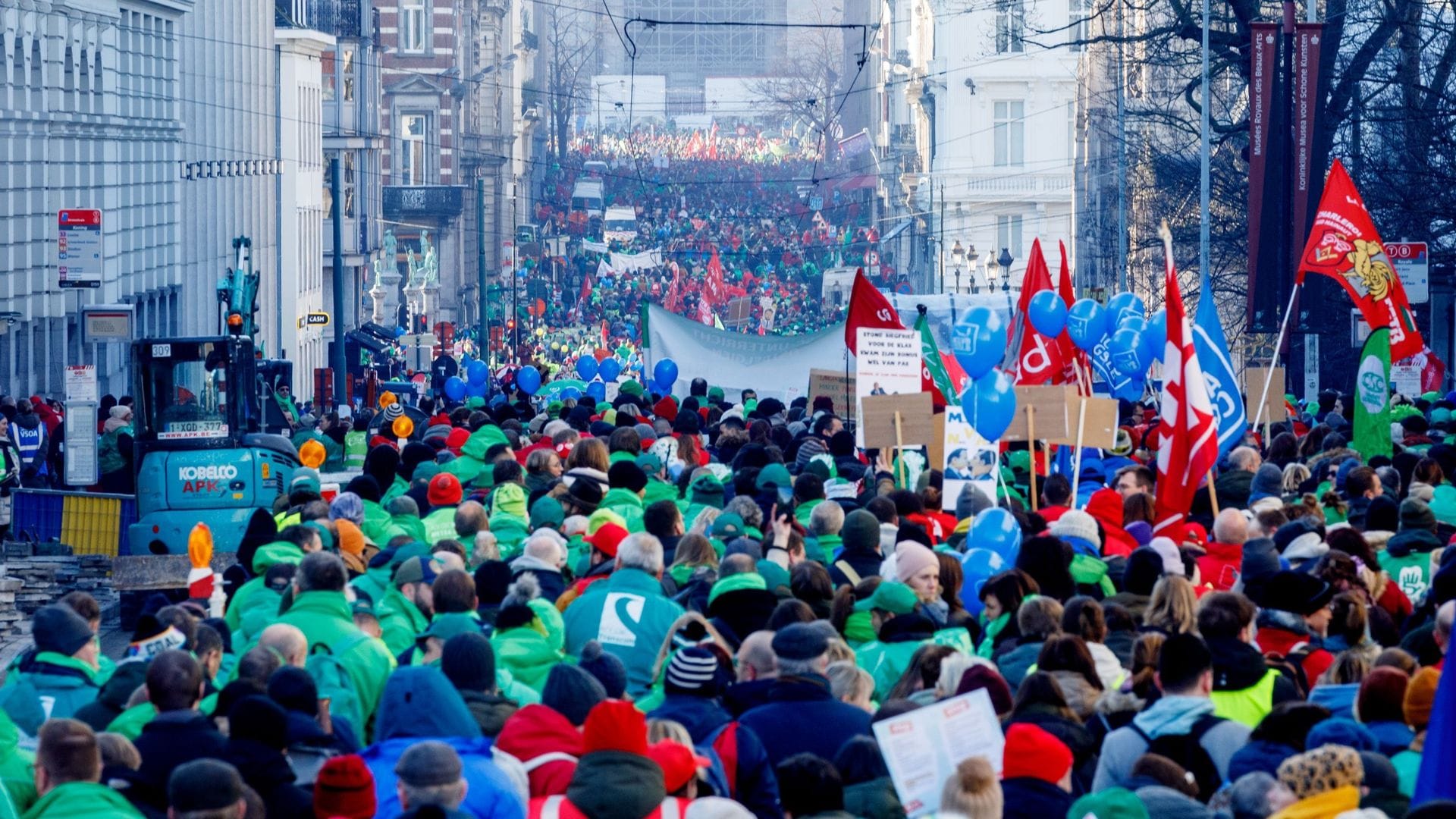
The first day of the strike saw strong participation among railway workers, with two-thirds of them absent from their jobs. High participation in air transport led to the cancellation of 40% of flights, despite the minimum staffing levels imposed since 2018. Massive mobilisations took place. In Brussels alone, between 30,000 and 50,000 people took to the streets.
On 27 January, the second day of the strike took place, with education workers mobilising particularly, achieving a one-third participation rate. The government responded by dismissing approximately 500 education workers. Automotive workers also took part, a sector suffering the impact of the German crisis, which led Audi to announce the dismissal of 4,000 workers from its Brussels plant. Workers confiscated the keys of 200 cars as a protest.
On 13 February, the third day of the strike took place. It was the most successful of all, with widespread participation from railway workers, air transport workers, teachers, and the public administration. Military and police personnel, who had the day off, also took part.
The lack of resolution of the demands and the government’s insistence on its plans… The austerity measures provoked a greater accumulation of anger and rejection, and on 14 October, a massive mobilisation took place, the largest in the last 40 years, when more than 140,000 people mobilised throughout the country. On 7 September, 110,000 demonstrated to stand by Palestine against Israel’s criminal genocide.
Strikes return in protest against the approval of the 2026 budget
At the end of November, Bart De Wever requested a 50-day extension from King Felipe to approve the draft budget for 2026. The delay in presenting the budget was because of the deepening rifts within the governing coalition regarding the VAT increase and the impact of cuts to social benefits. Finally, the coalition reached an anti-worker and austerity-driven agreement, and the new budget was announced on 24 February, the same day as a three-day general strike.
The first day of the strike was successfully executed on Monday, 24th, paralysing public transport and rail services throughout the country. On Tuesday, workers from other public services joined in: administrative staff, hospitals, postal workers, and educators. On Wednesday, the strike became general, taking place in the private sector with pickets and demonstrations across the country.
The budget presented and defended by the far-right government led by Bart De Wever seeks to impose budget cuts to pensions, social benefits, health, education, and culture to raise 10 billion euros by 2030, to pay off the country’s massive debt. “Our budget is structurally in deficit,” argued the prime minister, adding that “if you don’t dare to take drastic measures, you are not worthy of governing”; a recurring assertion among new far-right governments like Meloni in Italy or Milei in Argentina, which has aroused the greatest hatred among the working class.
The new budget includes a freeze on salary indexation for inflation for workers and pensioners, which would cut the wages of 41% of employees. With the “back to work” plan, it seeks to force the reinstatement of 100,000 workers on extended leave and impose an increase in co-payments for medical visits. Special taxes on gas will be increased. While the general increase in VAT was not included in order to secure the overall support of the governing coalition in Congress, VAT will be increased on hotels and campsites, sporting, cultural, and recreational events, and air travel. Furthermore, the “Arizona government” seeks to extend the workday for teachers without a salary increase, raise the cost of university education, and impose higher taxes on gasoline and fuel.
While the government maintains historic cuts to the working class, like the rest of the governments in Europe, a sharp increase in defence spending is underway with a budget increase of 4 billion euros to meet NATO’s 2% of GDP standard by 2025 instead of 2029.
The Belgian General Federation of Labour (FGTB), as the largest trade union, and the Workers’ Party of Belgium (PTB), both critics of the government, must prepare to build a plan of action to defeat the government without taking a single step back or yielding to the underhanded negotiations behind the backs of the workers that Bart De Wever is trying to impose, threatening to resign if an agreement is not reached in parliament. The mobilisation in Belgium must continue and intensify alongside the wave of strikes sweeping across Europe.
A fresh wave of strikes is sweeping across Europe
Major strikes in Belgium are not isolated actions. They are a response to the policies pursued by governments that, according to the Eurostat report, left 21% of the population—93.3 million people in the EU—at risk of poverty or social exclusion in 2024, while they prepare to increase defence spending[i] by €800 billion to fuel the war machine.
In France, on 10 September, thousands took to the streets to protest the 2026 budget plan presented by former Prime Minister François Bayrou, which included cuts of up to €44 billion and the elimination of two public holidays. Parliament defeated Bayrou, and Sébastien Lecornu replaced him, maintaining the austerity measures. On Thursday, 18 September, a general strike took place with demonstrations in the country’s major cities, called by all the major trade unions, which reported that over one million people joined in nationwide that day. On 2 December 2025, a new strike took place and nearly 32,000 people mobilised in the streets of Paris and in 150 other demonstrations held in various cities across the country.
In Italy, the general strike on the 28th and 29th October showed the fighting spirit of Italian workers who, since the inauguration of the far-right Giorgia Meloni, have not ceased mobilising and are now continuing their actions against the austerity budget and maintaining their solidarity with Gaza, Palestine, and against the Israeli genocide. During the massive strike on 3 October, in which the militant USB and the CGIL agreed to “stop everything,” historic mobilisations took place with over two million people to condemn the interception and hijacking of the Global Sumud Flotilla, which was heading to Gaza to break the siege. The mobilisations on the 28th and 29th were powerful and strongly supported by the student movement. The strike days were also effective; although the CGIL withdrew from the call and is preparing a general strike for 12 December.
In Portugal, the AD (PSD/CDS) government, with the support of Chega, IL, and all employers’ associations, is carrying out the largest offensive against workers since the Troika’s intervention with a new labour reform. Through this reform, they seek to impose irregular working hours and strip workers of job security, facilitate dismissals, and extend probationary periods under the false pretence of “modernising labour relations,” thus institutionalising precariousness and paving the way for a labour relations model based on total flexibility, low wages, and permanent insecurity. Workers forced the CGTP and UGT, after months of paralysis and negotiations, to call a general strike on 11 December, joining the wave of strikes sweeping across Europe.
The working-class and impoverished people of Europe must sustain and expand these massive responses to defeat the government budgets that funnel millions of euros to the reactionary arms industry. The upcoming strikes on 11 December in Portugal and 12 December in Italy can succeed and defeat each government, paving the way for the reorganisation of workers, students, and the dissident women’s and gender-non-conformist movement. Strikes and mobilisations, along with the millions of activists supporting the struggle for a free Palestine from the River to the Sea, are showing the way to confront Trump’s imperialist counter-offensive, his partners in the European Union, and the far-right, liberal, or social-democratic governments that seek to dismantle the historic gains of workers.
3 December 2025
[i] Not a single euro for imperialist rearmament; public money for salaries, pensions, employment, and social spending – Uit-Ci