By Miguel Sorans, a leader of the Socialist Left (IS), Argentina, and the IWU-FI
The situation in Venezuela following the military intervention by the far-right Trump and the United States on 3 January, besides the widespread condemnation, raises many doubts and questions: Is the situation over? Did Trump’s plan succeed? Is he already governing Venezuela? Will he manage to steal its oil? Did they strike a pact with the Chavista regime to co-govern, without Maduro? Will there be new military interventions in Colombia, Mexico, Cuba, Iran, or Greenland? We, the anti-imperialist fighters, must strive to answer these questions, while continuing to promote international mobilisation to defeat Trump, imperialism, and its colonial plans in Venezuela and the world.
Imperialism launched a direct attack against Venezuela and Latin America, unprecedented since the 1989 invasion of Panama.
Since then, there has not been a criminal military intervention like this one by Trump, and it is the first to be carried out in South America. In December 1989, US imperialism invaded Panama, which resulted in many deaths, and it kidnapped President Manuel Noriega, who the US imprisoned and tried. While the attack on Venezuela has not, for now, reached the scale of Panama, it is also a criminal military action. So far, 100 deaths have been confirmed among Cuban and Venezuelan military personnel and civilians, and more than 100 wounded, figures that may increase in the coming days. There was a serious bombing of military installations and civilian homes. Clearly, there is a worldwide condemnation of this intervention, the bombings, and the kidnapping of President Nicolás Maduro and his wife.
Trump himself has confirmed that the military action was not aimed at combating drug trafficking or promoting a democratic opening in Venezuela. With his statements, he has made it clear that his main objective is to seize control of Venezuela’s oil. Venezuela is the largest oil-producing country in Latin America and has the world’s largest crude oil reserves, surpassing those of Saudi Arabia. Trump went so far as to announce his intention to maintain indefinite control of the country for months or years, and to control the entire oil business. In effect, he is attempting to colonise Venezuela, turning it into a protectorate at the service of American and global multinational corporations.
And emboldened by the military action in Venezuela and the kidnapping of Maduro, which he hails as a victory, he has revived threats to annex Greenland, an autonomous region that is part of Denmark, a European country. He has also threatened to intervene in Colombia, Mexico, Cuba, and even Iran.
Trump’s military aggression is part of his plan to restore US dominance. The US never got over its military defeat in Vietnam in 1975. In 2021, they had a hasty withdrawal from Afghanistan after 20 years of failed occupation. That’s why, when Trump took office, he said he was going to end “the decline of the US” and that a “golden age” was beginning, seeking a new world “order.” But what his policies are actually causing is an increase in global disorder and clashes and friction between the bourgeoisie in the US and with the rest of the imperialist countries, including the European Union (EU), China, and Russia. That’s why the EU has distanced itself from the situation in Venezuela, especially given the threats that he wants to take over Greenland, possibly through negotiation, but without ruling out military action.
In Venezuela, Trump’s objective is to control the oil, its distribution, and the profits. That was the objective of a recent meeting at the White House with several CEOs of multinational oil companies from the US and other countries, whom he urged investing in Venezuela. However, this creates friction with the multinational corporations themselves and the imperialist countries that seek to control their oil businesses. That’s why the aforementioned meeting lacked enthusiasm and yielded nothing concrete regarding their proposal for them to invest approximately $100 billion of their own money.
In this context, clashes are escalating with Russia, whose ships are being seized, and especially with China, which receives nearly 70% of Venezuela’s oil exports, which represents a mere 4% of the oil imported by the Asian giant. Therefore, Trump’s entire oil plan is in doubt.
The situation in Venezuela is neither resolved nor stabilised
It is evident that negotiations are underway with the government of Delcy Rodriguez, representing Chavismo without Maduro, but it is not yet guaranteed that an agreement will be reached for the delivery of oil and a co-governance arrangement with the U.S. That is why Trump, in his bluster, said that if Delcy Rodríguez is not following through on his promise that “it could end worse than Maduro.” This is a very serious threat. What could be worse than the kidnapping of Maduro and his wife? Is it a death threat? He has also said that he does not rule out a second military action. They are negotiating based on these threats, which is why the IWU-FI calls for continued international unity against the military intervention and kidnapping of Maduro, as well as against a new criminal military action or an invasion of Venezuela, while also warning of the danger that the Chavista government might end up making a deal with Trump.
For all these reasons, we believe that Trump’s action is not a definitive victory. Undoubtedly, the success of the military action to kidnap Maduro is a demonstration of US military power and a blow to the Venezuelan people and the peoples of the world, but it is not a definitive victory. He has not yet dared to invade Venezuela and install a puppet government. He has to negotiate with the Chavista regime, revealing his weaknesses.
Undoubtedly, Maduro’s kidnapping is a spectacular event that provoked misguided euphoria among millions of Venezuelans in exile, who support the right-wing and pro-American María Corina Machado, as well as the global right wing. Among them is the fascist Javier Milei, president of Argentina. But this euphoria was short-lived when it became clear that Trump had abandoned the possibility of installing the supposed president-elect, Edmundo Gonzalez, and Maria Corina Machado in the government. And that the eventual “transition,” announced by Trump, would be with Chavismo but without Maduro. Trump’s declaration compounded this cold shower that there would be no elections and that a call for them could only be included in a supposed “third phase” that could last for years. Such was the confusion that, for now, even Milei himself has remained silent.
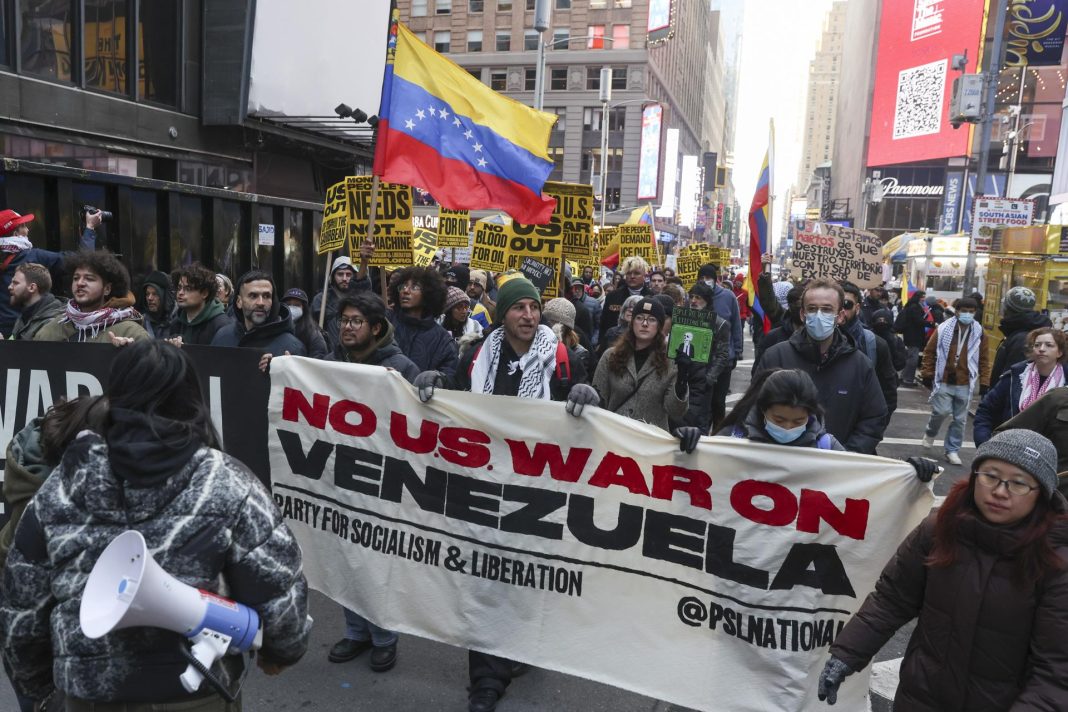
Trump’s contradictions and political weakness have been laid bare within the United States. Days before the military intervention, the Republican-majority Senate voted against any further US military intervention abroad. Trump was furious with his senators. On the other hand, polls indicate that 70% of the population opposes Trump invading other countries, and 60% oppose his taking over the government of Venezuela. This 60% holds considerable sway within the base of his famous MAGA movement, because this conservative and right-wing base readily accepted Trump’s campaign promise not to intervene in any more wars or conflicts abroad, and that spending could not be on defense, but that “America First.” Simultaneously, protests and marches against intervention in Venezuela are growing across the country, intertwining with the mobilisations condemning the police killing of Renee Nicole Good, a 37-year-old American woman who was protesting in Minneapolis, Minnesota, against the presence of Immigration and Customs Enforcement (ICE) agents deployed by Donald Trump in several cities under Democratic administrations.
Trump publicly supported the federal agent involved in the shooting and blamed the deceased woman for the incident. Civil liberties and migrant rights groups have called for thousands of events nationwide to condemn the crime and demand the withdrawal of ICE agents from the streets of the cities where they are present. The mobilisations, under the slogan “ICE Out for Good,” a play on words with the slain activist’s last name, can be translated as either “ICE out for good” or “ICE out in Good’s name.” In short, Trump doesn’t have everything in his favour.
Ongoing Negotiations
The other question to answer is whether the Chavista government in Venezuela is already being remotely controlled by Trump. He never tires of saying that he is the one governing, the one “in charge,” even going so far as to declare himself “interim president” of Venezuela on social media. Trump never tires of praising interim president Delcy Rodríguez, although he also never stops threatening her. The Chavista government, without Maduro, also doesn’t give a categorical answer and doesn’t deny that they are negotiating and willing to “cooperate” with Trump, as he has stated.
From the beginning, doubts were sown about the relationship with Trump, also because of how the kidnapping of Maduro and his wife was carried out. Some bourgeois analysts raised the hypothesis that the Chavista regime itself handed them over as bargaining chips. Given how the kidnapping unfolded, it’s understandable that doubts have arisen. But we believe that, it was an efficient massacre by imperialism that murdered 32 Cuban soldiers from Maduro’s personal guard and more than 25 Venezuelan soldiers, using its technological superiority and overwhelming military power, which we cannot deny. This is not the first time they have carried out a surgical operation of this kind.
Similar to when, under the Democratic administration of Barack Obama, Osama Bin Laden was captured and subsequently killed in Pakistan (2011), Israel also carries out these types of interventions, which always have internal support in the countries where they are implemented. Here, it is likely that this was combined, presumably, with internal Chavista collaborators bought off by the CIA, and also with the weakness of Venezuela’s own military defense, which is more dedicated to business and internal repression than to preparing to defend the country. In fact, the US acknowledged having a mole infiltrated by the CIA in Maduro’s inner circle, who regularly reported on his movements. Time will tell what really happened.
To date, there is no political evidence or event demonstrating that a significant division has occurred within the Chavista government leadership, either in the PSUV or the Bolivarian National Armed Forces (FANB), beyond the expected elements of crisis following an action like the one that took place. Of course, a division within the regime cannot be ruled out in the future. However, so far the political unity of the Rodríguez siblings (Delcy and Jorge, president of the National Assembly), the FANB leadership, headed by Vladimir Padrino Lopez, Minister of Defense, and Diosdado Cabello, Minister of the Interior, who controls internal repression, has remained intact.
What is happening, however, is that due to Trump’s weakness and his own political contradictions in his attempt to implement his counterrevolutionary policies, he is forced to combine the “big stick” of the famous Monroe Doctrine with elements of negotiation with the Chavista regime. Trump, quite nonchalantly, announced that he is working, and that his objective is to continue working with the Chavista regime. For this, he also counts on the willingness of Chavismo, which thus highlights what we have always denounced: that it is not, nor was it ever, a left-wing or truly anti-imperialist government building socialism. It has always been a capitalist government, one of class conciliation with a double “socialist” discourse.
The political shift of the far-right Trump, seeking to forge a pact with the Chavista government, which he accused of being a “narco-dictatorship” and “communist,” is striking. This can be explained by his cynicism and also because multinational oil companies, always present in the country, have opposed direct military intervention in Venezuela, preferring the stability of a dictatorial regime, regardless of its ideology, to the possibility of political destabilization that could jeopardize their businesses. This was confirmed by Ali Moshiri, currently an investor in Argentina’s Vaca Muerta shale formation, who spent 40 years as a top executive at Chevron, the only US oil company that remained in Venezuela:
“It’s important that it be someone from the current system, whether people like it or not, because that person has to balance everything and have the capacity for dialogue. If someone completely new is brought in, a power vacuum is created, and that vacuum generates insecurity, and nobody is going to invest.” (Clarin, Argentina, 8 January 2026). Moshiri had good relations with Hugo Chávez. On February 11, 2010, during the ceremony for the awarding of a 40-year concession (to Chevron) in the Orinoco Oil Belt, Venezuelan President Chávez asked Ali Moshiri, the transnational corporation’s representative, to mediate with Obama: “[Hopefully] you will help us improve the situation and relations with the United States government […] hopefully Obama will come to the Orinoco Belt, bring him here yourselves” (Why_did_Chavismo_fail.pdf).
The Lie of “21st Century Socialism”
The danger of a political-economic pact between the Chavista government and Trump becoming entrenched is real. The Socialism and Liberty Party (PSL), the Venezuelan section of the IWU-FI, has correctly warned this (see the PSL statement, ¡No a un pacto con Trump para profundizar la entrega del petróleo y nuestros recursos!–Uit-Ci).
We are talking about an agreement against the Venezuelan working people and popular sectors, one that would deepen the handover of oil to multinationals and national private businesses.
This political possibility, in some ways scandalous, can only be explained by the definition we have been making for more than 20 years: that the so-called “Socialism of the 21st Century” was a political-ideological fraud, designed to keep Venezuela within the framework of capitalism. It is time for anti-capitalist fighters around the world to share this conclusion. The definitions held by bourgeois analysts, shared by sectors of the global reformist left, that the Chavista regime was socialist, anti-capitalist, and anti-imperialist, were never accurate. Even sectors of the Trotskyist left encouraged the idea that it was quite possible that it would radicalize and advance toward socialism, in the style of 1960s Cuba.
The IWU-FI, together with our comrades from the PSL of Venezuela, led by the historic socialist leaders Orlando Chirino, Jose Bodas, and Miguel Angel Hernandez, always maintained that Chavismo, under Hugo Chávez and later Maduro, was not headed toward a break with capitalism nor toward socialism. Our current of the Trotskyist left, founded by Nahuel Moreno (1924–1987, see nahuelmoreno.org), was always independent of the Chavista government and warned of the dangers inherent in its conciliation with multinational corporations and big business. We always stood with the struggles of the workers’ movement and in the fight against the Chavista union bureaucracy. As a consequence of our independent stance, in November 2008 we suffered the assassination of labour leaders Richard Gallardo, Luis Hernández, and Carlos Requena, leaders of UNETE, the labour federation of Aragua state. A professional hitman gunned them down in a restaurant in La Encrucijada, where they were having dinner after a successful strike in the area. Gallardo was president of UNETE-Aragua, Hernández was general secretary of the Pepsi Cola union, and Carlos Requena was a safety representative for the Produvisa company. All three were members of our labour movement, the Autonomous Revolutionary Unitary Classist Current (CCURA), and of our party, now the PSL (see laclase.info). The case remains unsolved.
We define the Chavista regime as bourgeois Stalinist. What does that mean? It means it is a capitalist and repressive regime with a false socialist and anti-imperialist discourse: “21st Century Socialism.” It is a capitalist dictatorship, but with the peculiarity that it calls itself “socialist” and “revolutionary.” They claim to support Palestine and sometimes even quote Lenin and Trotsky, as Chávez did. This is the basis of our characterization of the regime as bourgeois Stalinist, to distinguish it from counter-revolutionary bourgeois dictatorships like those of Videla or Pinochet. Nicaragua and Cuba, with their own particularities, are also bourgeois Stalinist regimes. All of them, especially Chavismo, tarnish the name of socialism, creating tremendous confusion about the mass movement and its consciousness, since while they use pseudo-leftist rhetoric, they are capitalist governments that implement austerity measures and make deals with transnational corporations.
The confusion surrounding the lie of “21st Century Socialism” has reached such a point that, unfortunately, both bourgeois and left-wing media analysts continue to ignore the fact that multinational oil companies and large private businesses always operated under Chavismo.
Trump’s claim that “multinational oil companies have to return” to Venezuela is false; in reality, they were always there they never left. And it is even repeated that Chavismo nationalized the oil industry, which is completely untrue.
In 1975, it was the government of the social democrat Carlos Andrés Pérez that decreed the nationalization of the oil industry and created the state-owned company PDVSA. Millions in compensation were agreed upon and paid to the transnational corporations, and Article 5 of the law nationalizing the oil industry left the door open for the re-entry of transnational capital into the industry through so-called service contracts. This is what actually happened in the 1990s with President Rafael Caldera’s so-called “Oil Opening.”
What Chavez did was replace the commercial agreements and concessions under which transnational corporations, including those from the U.S., operated in Venezuela with joint ventures. Chavez did not nationalise the oil industry. It’s that simple.
On 1 January 2006, the plan was announced under the grandiose name of Full Oil Sovereignty, whereby the Chavez government opened PDVSA, the state-owned oil company, to the joint venture model. Under this plan, multinational corporations and national private companies, which had previously operated under concession agreements, became PDVSA’s partner companies. The only exception was that: “In the process of migrating contractors to joint ventures, it was stipulated that the State would achieve a minimum 51% stake.” And up to 49% of the shares were reserved for transnational capital. Among the first companies to sign the agreements were Chevron, Repsol, Shell, BP, Total, China National Petroleum, ENI, Statoil, and Petrobras. Only two companies refused to restructure and withdrew: the American companies Exxon Mobil and Conoco Phillips. They were not nationalized by Chavez. They left. Later, the Japanese company Mitsubishi and the Russian companies Lukoil, Gazprom, and Rosneft joined the joint ventures, as well as companies from Iran, India, Vietnam, Cuba, and other countries. (Why_did_Chavismo_fail.pdf)
This is very important because, in reality, Maduro, until the day of his kidnapping, continued offering to make deals with US oil investors. Let’s recall his words in June 2024, with the president of Chevron-Venezuela by his side: “My name is Nicolas Maduro Moros, I am the president of the Bolivarian Republic of Venezuela, a man of my word, a trustworthy man. Your investment in Venezuela is welcome so that we can work towards a different relationship between the United States and Venezuela” (International Correspondence N°53: Stop the genocide. Gaza resists Palestine Lives – Uit-Ci).
Chevron never left, and today almost 27% of Venezuelan oil exports go to the US via Chevron. That’s why Delcy Rodríguez says the relationship with the US is nothing new.
Business and the military
Precisely what is called 21st-century Socialism It failed, among other things, because Chavismo made deals with multinational oil companies to create joint ventures, transforming companies that were previously contractors into partners in the oil business with PDVSA, while the state-owned company retained a majority stake. In this way, the multinationals, the new oil entrepreneurs, and the regime’s newly rich, often associated with private sectors, reaped the huge profits. This allowed capitalism to persist in Venezuela, exacerbating the poverty of the working class and the popular sectors.
The shady dealings woven around the oil business were and continue to be a source of corruption for the Chavista regime, especially for the military, who, along with civilians, still control dozens of companies in various economic sectors. It is precisely these sectors, enriched in the shadow of oil, that are popularly known as the “Bolivarian bourgeoisie.” A new social phenomenon created from the rise of Chavismo and the lie of 21st-century socialism.
Between 1999 and In 2013, under Chávez’s presidency, 1,614 military personnel held high-ranking government positions. His successor, Maduro, between 2013 and 2017, created 14 military-owned companies: Constructora y Automotores Ipsfa, Emcofanb (telecommunications), TVfanb (television), Emiltra (transportation), Agrofanb (agriculture), Banfanb (bank), Construfanb (construction), Cancorfanb (quarry), Fondo Negro Primero (financial institution), Complejo Industria Tiuna I and II (water and clothing), Camimpeg (oil and mining), Neumalba (tires), and Imprefanb (printing). (Why_did_Chavismo_fail.pdf).
The conflict between the pro-American Venezuelan right wing (María Corina Machado, Guaido, Leopoldo Lopez, and Capriles) and Chavismo stems from their desire to regain control of these businesses by making direct deals with the US government. Transnational corporations and imperialism. None of them, least of all Trump, aim to raise the standard of living for workers and end social inequality.
From the outset, the PSL and its CCURA union current have denounced the falsity of 21st-century socialism, insofar as it has maintained the surrender of oil resources within a capitalist economy. They always said it was headed for failure, and that this failure would exacerbate the poverty of the working people.
Chavismo did not use the potential of oil wealth to raise the standard of living for the working class, improve health, education, housing, and even the production of food and medicine, which is a historical deficit in Venezuela.
That is why our current proposed a different policy and raised the slogan of breaking with capitalism: that oil in Venezuela should be 100% state-owned, without multinational corporations, under workers’ and people’s management and control. And that true socialism required achieving a workers’ government that would implement this plan. The Chavista government led the country into a profound crisis. The social and economic crisis was the largest in its entire history. It caused an abrupt drop in the standard of living, unprecedented in Venezuelan history. Today, the minimum wage is less than one dollar. It led millions of workers and popular sectors to abandon their expectations of Chavismo, and more than 7 million to leave the country. Others, driven by impotence and hatred of Maduro and his government, mistakenly encouraged imperialist intervention. This is the sad reality. That is why there have been practically no mobilisations in the streets of the country repudiating the US military aggression. These are the consequences.
We reject any pact or agreement to deliver oil with Trump
Our movement continues to call for the broadest unity of action in Venezuela and the world to repudiate Trump’s military aggression and against any other attempt at aggression against Colombia or other countries. But we do so from the opposition.
We from the left oppose the Chavista government, now headed by Delcy Rodríguez. The centre is on defeating Trump and his neocolonial agenda, but we neither support nor place our trust in the current Chavista government.
There is a danger that they will move forward with a pact with Trump, which would mean a greater surrender of Venezuela’s oil and mineral and natural wealth, deepening the poverty of the masses and exacerbating the social crisis and the country’s surrender. There is also a danger that repression will continue. Although a partial release of political prisoners has been announced, many oil union members and others remain detained for their activism and for political reasons.
Therefore, from the PSL (Socialism and Freedom Party) and the IWU-FI, we call on the working people and popular sectors of Venezuela not to be misled or have expectations of Trump, and to reject any pact between the government and the US, starting with a greater surrender of oil. We believe that the only way out of the social crisis caused by Chavismo is not by following the right-wing, pro-business parties currently led by Maria Corina Machado, and even less so Trump, but by the working class and popular sectors mobilizing and demanding their rights. Along this path, we must continue fighting for a genuine, fundamental solution: a government of the workers. A true socialism, not the farce of so-called 21st-century socialism.
In this regard, we support the action program put forward by the PSL of Venezuela: “We must mobilise for an emergency increase in salaries and pensions, equal to the cost of the basic food basket. Enough with austerity measures for the working people! Enough with salary bonuses! Collective bargaining agreements must be discussed; for the right to strike and freedom of association; for the full freedom of political prisoners, including those who have already been released, and freedom for those arrested during the protests against the electoral fraud in July 2024. The release of prisoners announced by Jorge Rodriguez must be expedited. We especially demand the freedom of workers detained for fighting, for denouncing corruption, or for political reasons, as is the case of more than 120 oil workers who remain detained, and that they be reinstated to their positions. Immediate reinstatement of those dismissed with back pay. An end to repression and persecution! Immediate lifting of the decree of external commotion! The [unclear] must be opened Media outlets that were shut down. Full political rights for the working people. Legalisation of left-wing and democratic political parties. We demand 100% state-owned oil, without joint ventures or transnational corporations; progressive taxes for all transnational and large national companies, and that all this money be allocated to wage increases, health, education, and the production of food and medicine” (See the full statement at uit-ci.org or laclase.info).
The PSL also demands that the government of Delcy Rodríguez, instead of negotiating with Trump, call for an International Day of Struggle against interventionism, since only the unity of the peoples of Latin America and the world can defeat the nefarious plans of the far-right Trump.
We call for continued mobilisation against Trump’s interventionist aggression
A new military action by Trump in Venezuela, Latin America, or Greenland is not out of the question. As we have pointed out, Venezuela’s situation is still uncertain. Trump has already said that if the Chavista government does not comply, there will be further military action. He has also threatened Colombia, Cuba, Mexico, and Iran, and wants to annex Greenland.
Therefore, we, from the IWU-FI and the PSL, reiterate our call for the broadest possible unity of action to continue the mobilisation in Latin America and the world, to condemn the military intervention in Venezuela and the danger of further interventions. The presidents of Colombia, Brazil, Chile, and Mexico have rejected Trump’s aggressive threats. We must demand that they move from words to action and call for a continental mobilisation to defeat Trump’s colonial aggression. Something they have not yet done. Therefore, the priority is to demand that political, labour, student, women, and sex divergent organisations that identify as democratic and anti-imperialist call for unified mobilisations in the streets or in front of US embassies or consulates in each country and coordinate a call for a day of continental struggle. To stop and defeat the far-right Trump, we must build a large, united Latin American and global movement. Let’s take to the streets to condemn the attempt to steal Venezuelan oil, to condemn the kidnapping of Maduro, and the threats to maintain the oil blockade against Venezuela. American ships out of the Caribbean! Enough!
Criminal bombings in the Pacific and the Caribbean. No to threats against Colombia, Cuba, Mexico, or Greenland. Let’s fight together for Trump out of Venezuela and Latin America.
12 January 2026
(1) China imports 11,100,000 barrels of oil per day. About 400,000 come from Venezuela (U.S. Energy Information Administration data, February 11, 2025).
(2) See the report on Miguel Angel Hernandez https://youtu.be/aiPkbiflYnU